A blog to share my love of floristry and gardening, with occasional distractions from my other loves - films, literature, and art.
Monday, 28 September 2015
Super blood moon
Last year I managed to take some decent photos of the supermoon. This morning, I tried to take photos of the "super blood moon", where a supermoon and lunar eclipse coincided.
I didn't use a tripod, and the exposure was so slow, most of my photos came out like this.
Some came out like this, looking like a red bubble machine.
When I tried to do something arty, like photo eucalyptus next to the moon, I couldn't focus on either of them.
But. I got up, went outside, and saw it with my own eyes. The poet Gemma Selzer reminded me that I was shaky because I was excited to see something so cool. It's true. That's the important thing - the experience. It's easy to forget that sometimes.
Thursday, 10 September 2015
Leave it to compost
I had a wonderful English Literature tutor called Mark Loveridge when I studied at Swansea. It was he who decided I could do the undergraduate degree despite my inadequate A-level results, he who had the sort of brilliant energy and sense of humour that I'd only ever seen in films. And it was he who, when I felt like submitting a first draft of an essay, told me to, "Leave it to compost for a few weeks," before tackling it again.
Leave it to compost.
For someone like me, who overthinks, overplans, then gets frustrated and disappointed when things don't go to plan, or when I get tired or bored, this piece of advice was invaluable.
So, as much as I've felt guilty about not blogging over the summer, despite being on holiday from my current uni course and technically having more brain space to write, I think it was necessary to have a break. I've never been great at the regular, frequent side of blogging - as you can probably tell, it's more feast or famine with me. But the point of starting this blog was to enjoy it, and there's nothing enjoyable about feeling guilty!
So there are lots of things I could share here, and I will share some of them and let the others sit there. Maybe they'll compost for another four months and it'll feel good to share them at Christmas when it's wintry and gloomy outside, and we need a reminder of sunnier days.
In July, there was a surprise party for a lady who went out and bought herself pink peonies the day before. Luckily I was told before I went to the market! These flowers are a mixture of market flowers (pale pink phlox, snapdragons, white gentian) and home grown ones (red phlox, panicum/fountain grass, nicotiana, jasmine and sweet peas). I was given most of the containers to fill, and it was fun using unfamiliar vases.
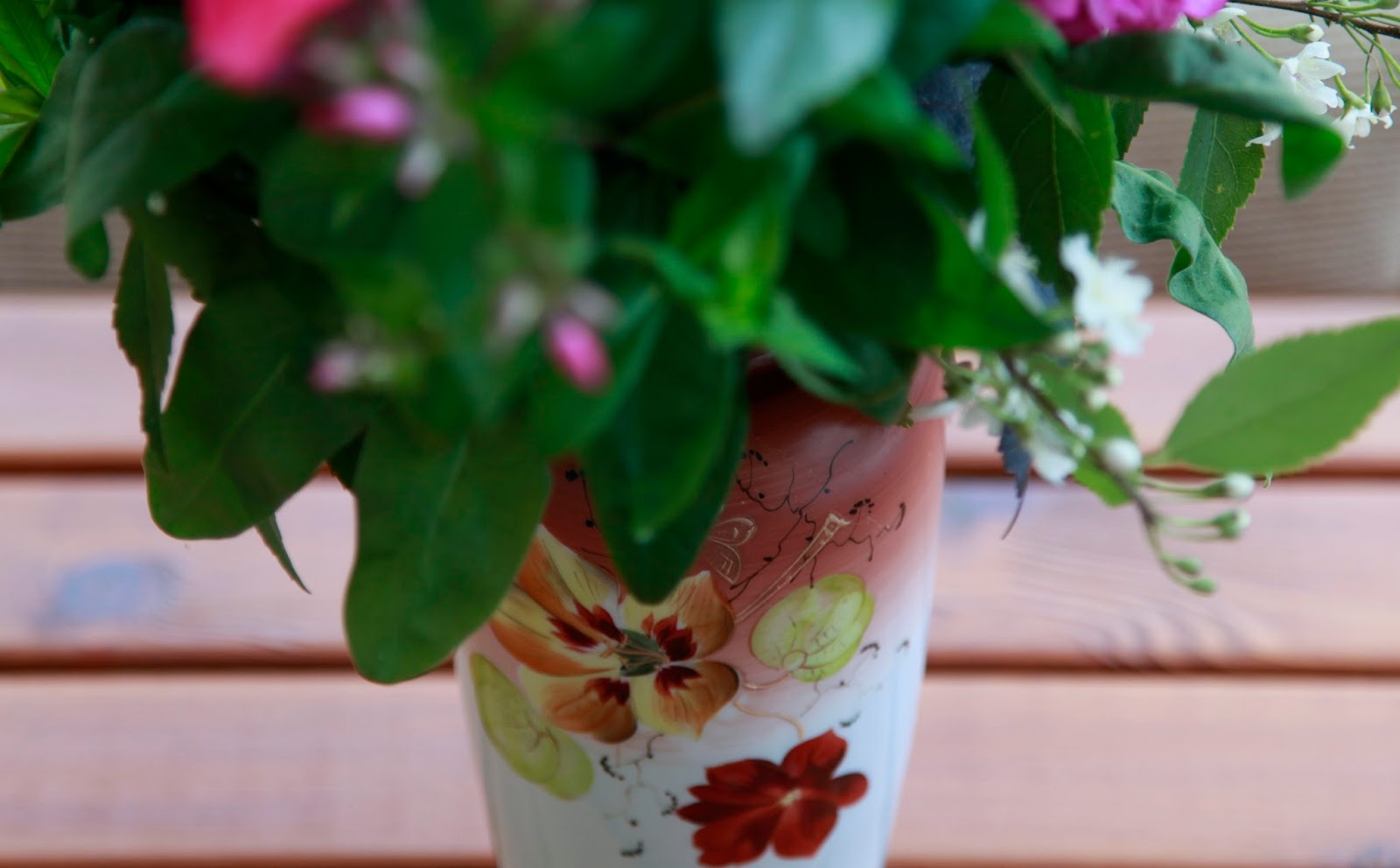
Particularly this autumnal one.
My Australian cousin was visiting briefly last week, and asked to go to the flower market. It was wonderful to have someone to help me choose, and to help me carry! As well as the market flowers, there were also buckets of sedum, roses, physocarpus, panicum and herbs from the garden, and foraged berries. It was also nice to use September flower in September.
Last weekend, I used the flowers for several bits, including this bouquet for a beautiful woman who liked the moody colours and chocolate scent of cosmos. This bouquet included one of my rare, homegrown dark sunflowers - which, unlike many of the sunflowers I've grown, has long enough stems to use in bouquets.
And of course, there were leftovers to enjoy. The chocolate cosmos scent fills the room - it's incredible that such a strong fragrance comes from such a dainty flower.
When these flowers die, you know where they'll end up? That's right - on the compost heap.
Labels:
Asters,
Astilibe,
Chocolate cosmos,
Cosmos,
Dahlias,
Fountain grass,
Gentian,
Grasses,
Herbs,
Phlox,
Roses,
Scent,
Sedum,
Snapdragons,
Writing
Tuesday, 11 August 2015
Sunflowers in the spotlight
Oh dear, has it really been four weeks since my last post? Sorry...I have excuses, but I won't bore you with them. I do have some new photos I want to share, and they follow on nicely from my last post about sunflowers.
Last month, two of my cousins from Canada came to London for their first visit to Europe. It was lovely to see them - the last time I saw them was several years ago when I did a two-week tour of Canada to see friends and family (and the polar bears). One of them is really into photography and wanted to take photos of London at night, so one balmy evening, we had a wonderful night out in the city. We went for dinner at Swan at Shakepeare's Globe (where she was bemused by the British thing of standing around in a pub for hours), walked along the river (where she was bemused by the British thing of standing around outside with a pint when it's warm outside), and went for cocktails/mocktails and much giggling at the OXO Tower. I don't have any decent photos, partly because I feel self-conscious taking photos in restaurants, but I did sketch our drinks the next day for #DrawingAugust.
My cousin took lots of good photographs, and I took a few dodgy ones:
I've not really taken "proper" photographs at night, except when I tried to get a decent shot of the supermoon.
I had some homegrown sunflowers and zinnias which started off like this (along with the biggest dahlias I've grown)...
...but as they died, I thought I would try to get a cinematic-looking photo of them in the dark. In Vic Brotherson's beautiful book, Vintage Flowers, she includes a photo of faded flowers that she'd forgotten about. I thought it was a lovely idea. But my dying sunflowers and zinnias would need something a bit more thoughtful than a quick camera-phone shot to look beautiful!
So I set up a camera on a tripod at night, used two different torches, and sometimes used a tissue over the torch to get a slightly less harsh spotlight. The ISO was 200 and the aperture was f/1.2, but the shutter speed varied. It was very slow though. I found it hard to focus using auto-focus, so I manually focused - but unfortunately, my eyes weren't sharp enough to notice that the sunflower on the left wasn't in focus a lot of the time. Anyhow, as a first attempt, I'm quite pleased with them. And it was fun playing about with different shadows. I like how the shadow of the sunflower on the right is so sharp and detailed compared to the blurry flowerhead.
I often forget to take photos of my new flowers, but now I can try to find beauty in my spent ones.
Wednesday, 15 July 2015
Sunflowers in time for Pollinator Awareness Week
I know there seems to be a special day, week or month for everything these days, but here is another one: Pollinator Awareness Week.
Bees are not my favourite things when I am faced with them. I've only been stung once, but that was quite enough for me, thank you. I was on a romantic date, watching Romeo and Juliet in Stratford-upon-Avon, looking very glamorous with an ice pack clamped to my arm all evening!
So even though I shy away from bees, I also grow flowers to attract them because I know how vital pollinators are. As luck would have it, the first sunflowers I've ever grown (from seed) showed their pretty faces this week. And the bees are all over them already!
I never used to like sunflowers much - they were too bright and impactful for me. But then my lovely ex bought me these once, and I came around to them. This is a terrible photo that I took of them, but the sunflowers were wonderful and made me smile.
Now I like to combine the yellow, happy flowers with equally impactful blue hydrangeas. I got these from Tregothnan - I don't think I'll ever grow hydrangeas as big as these and certainly not as blue.
Or more brights, such as the pink snapdragons, orange celosia, and lime green Thlasbi 'Green Bell' that I used here. And yes, bees did follow me as I carried these to the photoshoot!
Bees are not my favourite things when I am faced with them. I've only been stung once, but that was quite enough for me, thank you. I was on a romantic date, watching Romeo and Juliet in Stratford-upon-Avon, looking very glamorous with an ice pack clamped to my arm all evening!
So even though I shy away from bees, I also grow flowers to attract them because I know how vital pollinators are. As luck would have it, the first sunflowers I've ever grown (from seed) showed their pretty faces this week. And the bees are all over them already!
I never used to like sunflowers much - they were too bright and impactful for me. But then my lovely ex bought me these once, and I came around to them. This is a terrible photo that I took of them, but the sunflowers were wonderful and made me smile.
Now I like to combine the yellow, happy flowers with equally impactful blue hydrangeas. I got these from Tregothnan - I don't think I'll ever grow hydrangeas as big as these and certainly not as blue.
Or more brights, such as the pink snapdragons, orange celosia, and lime green Thlasbi 'Green Bell' that I used here. And yes, bees did follow me as I carried these to the photoshoot!
Monday, 13 July 2015
Describing autism
Following on, in a way, from my last post: I was interested to read some research on the language that is used to describe autism. The research was carried out by the National Autistic Society, the Royal College of GPs, and UCL's Institute of Education. If you are interested, you can read the full report here - it's nineteen pages of academic writing though, so you may need tea! I did. A shorter summary is on the NAS website here.
My personal opinions on and feelings about the findings and the research itself are jumbled and a bit raw, but I'll try to get some of it out here.
Having done such a big study (3470 respondents), it seems a shame not to have sought a more balanced sample. For example, of the parents questioned, 188 said they were male, but 1999 said they were female. That's a huge voice given in this instance to mothers, but not to fathers. Of the autistic people (as most of them preferred to be called, rather than "people with autism"), 450 were white, 25 were another ethnicity, and 27 didn't want to say. In both of these instances, I wonder how different the results would have been if the samples had been more representative of the population.
There were 2207 parents questioned, but siblings (I know, I know, I'm being very self-centred here!) were mixed up with the 380 "extended family members and friends". Forgive my egocentric bias, but really, I do think the relationship that a sibling has with an autistic person is different from relationships that aunts, uncles, cousins and friends have with them. For example, since childhood, I have understood that my sister will always need someone to care for her, and I have been aware that if anything happens to our parents, I will care for her. I will be the one who struggles (and it will be a hell of struggle) to explain to her why our parents aren't around - which will be difficult, if not impossible, given her limited vocabulary and (what I understand to be) her difficulty understanding concepts (such as illness and death, and even family). I don't have the distance of extended family members, who see my sister once a year, if that. I cannot detach my mind from her or her autism/learning disability.
Back to the research, and "person-first" phrases such as "person with autism" were preferred by professionals working in the field, while "identity-first" phrases such as "autistic person" were preferred by the autistic people who took part in the research. There was much debate about whether autism was part of a person, and whether adding a separate description makes it sound as though an autistic person has a choice about being autistic or not. I had not considered this point of view, and I can see the disparity. Personally, I prefer to say "my sister with autism" because she is my sister first and foremost, and someone with autism second. In her case, she wasn't diagnosed with brain-injury until she was a toddler, and then wasn't diagnosed with autism until she was in her late teens - so I certainly don't see her person and her autism as one and the same. It's difficult, because she doesn't have the communication skills to tell me what her preference would be, or even how she feels about her autism. All I have to go on is her behaviour - the times when she laughs and smiles, the times she strokes my hair, the times when she makes happy-sounding noises, the times when she makes anxious or angry-sounding noises, the times she pushes me away, the times she spits, bites or screams.
Finally, the huge dislike of the term "low-functioning autism" has led the NAS to drop the term - but it hasn't replaced it. I looked on the website just now and there is a section on the difference between high-functioning autism and Asperger's, but nothing on low-functioning (or an equivalent/alternative term). This itself feels rather alienating. In the research, there was also dislike of the term "high-functioning", but not to the same extent. Again, I can understand the dislike of the terms - they are simplistic, and many people find the term "low-functioning" derogatory. But my reasons for using the term "low-functioning" and occasionally the term "severe" are certainly not to cause offense.
I use these terms because so often, when I simply tell people that my sister is "autistic", the response is one of the following:
I use these terms because professionals will churn out the word "autistic" when it suits them, but then they will forget how serious my sister's learning disability is and how she is unable to ask for her needs...but that she still has needs.
Basically, I love my sister to pieces, I feel awful that she can't express herself the way I can, and I want people to make an effort with her - professionals and people she meets socially. The debate about language is an important one. It's the reason that terms that were used when my sister was young (the one beginning with "r" that I don't want to repeat, and "mentally handicapped") aren't used now. But as we find some words are not so helpful to everyone, we need to find new words that are more helpful to more people. If autism is a spectrum, there are a lot of people whose voices and needs ought to be listened to in future discussions about the language we use.
Back to the research, and "person-first" phrases such as "person with autism" were preferred by professionals working in the field, while "identity-first" phrases such as "autistic person" were preferred by the autistic people who took part in the research. There was much debate about whether autism was part of a person, and whether adding a separate description makes it sound as though an autistic person has a choice about being autistic or not. I had not considered this point of view, and I can see the disparity. Personally, I prefer to say "my sister with autism" because she is my sister first and foremost, and someone with autism second. In her case, she wasn't diagnosed with brain-injury until she was a toddler, and then wasn't diagnosed with autism until she was in her late teens - so I certainly don't see her person and her autism as one and the same. It's difficult, because she doesn't have the communication skills to tell me what her preference would be, or even how she feels about her autism. All I have to go on is her behaviour - the times when she laughs and smiles, the times she strokes my hair, the times when she makes happy-sounding noises, the times when she makes anxious or angry-sounding noises, the times she pushes me away, the times she spits, bites or screams.
Finally, the huge dislike of the term "low-functioning autism" has led the NAS to drop the term - but it hasn't replaced it. I looked on the website just now and there is a section on the difference between high-functioning autism and Asperger's, but nothing on low-functioning (or an equivalent/alternative term). This itself feels rather alienating. In the research, there was also dislike of the term "high-functioning", but not to the same extent. Again, I can understand the dislike of the terms - they are simplistic, and many people find the term "low-functioning" derogatory. But my reasons for using the term "low-functioning" and occasionally the term "severe" are certainly not to cause offense.
I use these terms because so often, when I simply tell people that my sister is "autistic", the response is one of the following:
- "Cool! Is she really good at drawing?"
- "Wow! Is she good at maths?"
- "Oh yeah, I'm a bit autistic too," before explaining that they like to line their shoes up neatly/tidy up the kitchen before they go to bed/do anything that a neat and tidy person would do.
I use these terms because professionals will churn out the word "autistic" when it suits them, but then they will forget how serious my sister's learning disability is and how she is unable to ask for her needs...but that she still has needs.
Basically, I love my sister to pieces, I feel awful that she can't express herself the way I can, and I want people to make an effort with her - professionals and people she meets socially. The debate about language is an important one. It's the reason that terms that were used when my sister was young (the one beginning with "r" that I don't want to repeat, and "mentally handicapped") aren't used now. But as we find some words are not so helpful to everyone, we need to find new words that are more helpful to more people. If autism is a spectrum, there are a lot of people whose voices and needs ought to be listened to in future discussions about the language we use.
Wednesday, 8 July 2015
Nymans in June: Smelling the roses
I watched the first episode of The Autistic Gardener this evening. I wasn't sure about the sound of it - I was worried it would be just another entertainment programme misrepresenting vulnerable people. But I watched it, and as all of the team had high-functioning autism, it did seem to be their story and edited sensitively. There was a lovely, warm sense of humour running throughout it, and some very tender moments.
It reminded me that I took some photos with my sister (who has low-functioning autism) just over a week ago that I wanted to share here.
We made another trip to Nymans, and there was a sensory treat in store for my sister. She has paid a couple of brief visits to the beautiful National Trust gardens, just sitting in the meadow or walking up the path and looking at the narcissi and crocuses - the staff are great at suggesting what is quick to see and not too far to walk to.
At the end of last month, when it was very warm but not horrendously hot, we paid another visit on the way to Brighton. We walked through the centre of the meadow and I ran my hand along the grasses, and she copied me. She took my photograph, but decided I look better with most of myself cropped out!
Nymans has left boxes around the place with activities for children and families. I demonstrated a skipping rope, very badly, but she didn't fancy skipping. I tried to get her to play giant noughts and crosses, and she sort of joined in.
We saw all sorts of colour emerging in the gardens.
Does anyone know what this is?
We sat down in the rose garden, and for the first time she really sniffed when I asked her to smell the roses. The heat meant the scent was even stronger. So although we didn't manage to see the bluebells or the wisteria this year, sitting in the rose garden surrounded by the most wonderful fragrance was a pretty cool achievement. She seemed happy.
It reminded me that I took some photos with my sister (who has low-functioning autism) just over a week ago that I wanted to share here.
We made another trip to Nymans, and there was a sensory treat in store for my sister. She has paid a couple of brief visits to the beautiful National Trust gardens, just sitting in the meadow or walking up the path and looking at the narcissi and crocuses - the staff are great at suggesting what is quick to see and not too far to walk to.
At the end of last month, when it was very warm but not horrendously hot, we paid another visit on the way to Brighton. We walked through the centre of the meadow and I ran my hand along the grasses, and she copied me. She took my photograph, but decided I look better with most of myself cropped out!
Nymans has left boxes around the place with activities for children and families. I demonstrated a skipping rope, very badly, but she didn't fancy skipping. I tried to get her to play giant noughts and crosses, and she sort of joined in.
We saw all sorts of colour emerging in the gardens.
Does anyone know what this is?
We sat down in the rose garden, and for the first time she really sniffed when I asked her to smell the roses. The heat meant the scent was even stronger. So although we didn't manage to see the bluebells or the wisteria this year, sitting in the rose garden surrounded by the most wonderful fragrance was a pretty cool achievement. She seemed happy.
Labels:
Autism,
Garden,
Grasses,
National Trust,
Nymans,
Roses,
Scent,
Television,
Wildflowers
British flowers at the Summer Tumblr Eco-Design Fair
I had a stall at the Summer Tumblr Eco-Design Fair at the Garden Museum. It was like the Christmas fair, but summery!
I had buckets of British flowers from the garden, from a friend's garden (she let me raid it with a bucket and scissors), and from Pratley and Dennis Edwards at New Covent Garden Market. Summer is certainly the best time to buy flowers - the prices are cheaper and more things are local. You can't get outdoor-grown sweet peas in January, and if you could (like imported peonies at Christmas) they would cost a bomb!
I got lovely, small poppy seedheads from my friend - the cultivated ones at the market are great for bigger arrangements, but are too dominant for smaller ones. I also snipped some feverfew (which means protection in the language of flowers) and scented dianthus (aka carnations).
Pratley was full of boxes of beautiful flowers...but the heat was getting to some of them. Even though the market is temperature-controlled, of course if it's hot outside (it was like a furnace outside on Saturday morning at 6am) it's going to seep indoors, particularly with doors opening and closing all of the time. I bought pale blue delphiniums, powder blue scabious (which I love to buy, in case you hadn't noticed), and white, lilac, and pink larkspur. Delphiniums symbolise levity and larkspur, their annual sisters, lightness. I was told that the (boxed) larkspur weren't happy with the sun, but I took a chance and bought some - hoping that several hours in water, flower food and a cold shed would perk them up (which it did).
Dennis Edwards (where you can buy David Austin cut roses and Withypitt dahlias) had British stocks, peonies, veronica, garden phlox, sweet peas, and alchemilla mollis. I bought pale peach stocks (which were in water and seemed much healthier than the stocks I sometimes see in boxes) and veronica.
This is how to condition garden hydrangeas - upside down in lots of water. Their delicate petals tend to wilt if they are not properly conditioned, and I guess it's hard work for them to suck up water from their woody stems if you condition them the usual way. After a few hours like this, I turn them upright.
I had a calamitous morning on the day of the fair, with a nosebleed ruining my outfit and my face, and my two left feet tripping up the stairs twice. But after that, there was calm (followed by a downpour of rain).
And I had some plants grown from the seeds that were given to me as a thank you for doing some funeral flowers last year - these are Impatiens balsamina.
The most popular seller? My friend's poppy seedheads!
And the posh Fortnum and Mason coffee tins of scabious and veronica.
I had a wonderful day, made even nicer by family and gardener friends from the museum helping out or stopping by to chat. And at the end of the day, two lovely things happened. A Swedish woman told me that the word for carnation in Swedish is the same as the word for clove, because of the scent. Ooh, what about stocks, I asked - they smell like cloves too. She smelled some stocks and smiled - oh yes.
Then a family bought a plant to give to a friend, and were going for a tea in the cafe and picking up the impatiens later. I was about to start packing away, but I had a small bucket with larkspur trimmings. So I made a posy with these and tied it with yellow ribbon. When they came back to pick up the plant, I gave the posy to their little girl. The shocked look on her face reminded me of when I went to Dickens and Jones (an old House of Fraser on Regent's Street) with my mother when I was a little girl, and a sales assistant gave me two perfume samples, which I thought were real bottles of perfume. At the stall, the girl's mother said, "Oh! You look like a flower girl," and the girl said a shy "Thank you" to me.
And that's what flowers are for.
Labels:
British Flowers,
Carnations,
Chamomile,
Delphiniums,
Feverfew,
Flower meanings,
Flower stall,
Garden,
Garden Museum,
Hydrangeas,
Jasmine,
Larkspur,
Physocarpus,
Roses,
Scabious,
Scent,
Seedheads,
Stocks,
Tins,
Veronica
Subscribe to:
Posts (Atom)