Showing posts with label Alstromeria. Show all posts

Saturday, 4 March 2017

Review of the year: Winter 2016


Only a few weeks to go before the days start getting longer again. I can't wait - apart from Christmas, I'm not a fan of dark mornings and evenings.

Winter flowers included 28 candelabras for an event at Middle Temple Hall celebrating Shakespeare (which chimed in nicely with the #floristfilms hashtag: 28 Candelabras Later). It's where the first recorded performance of Twelfth Night took place in 1602, so it was a real privilege to do the flowers for this event. The flowers were not so much flowers, as trailing ivy, which hopefully created an ethereal, Midsummer Night's Dream feel to the hall.


There were scented arrangements of pine, spruce (aka blue pine), eucalyptus, stocks, and lavender, along with pussy willow, alstromeria, silver brunia, silver kochia, and white hypericum for Neal's Yard Remedies in Sevenoaks.


The scent of the foliage, herbs, and flowers nicely complimented the Christmassy smells of cinnamon, clove and mandarin that filled the shop. Pussy willow has an irresistible, tactile quality, and it lasts for weeks and weeks, which is wonderful for a shop display.


Oh, and there was white, glittery skimmia. The glitter was barely noticeable in the arrangements, but it was all over my workspace and buckets and took weeks to finally clear!


There were satsumas for Father Christmas.


And on Boxing Day, after eating leftover Quorn roast (I used Nigella's ginger-glazed ham recipe), I used my leftover flowers to try to create some modern ikebana arrangements. Ikebana is not the most obvious style for Christmas flowers, but one of my lovely Canadian cousins sent me Keiko's Ikebana book to challenge my Western-wild floristry style, and I thought I'd give it a go. I failed my natural line arrangement practical at college, along with the rest of my class - this Japanese style of floristry did not come naturally to any of us (we scraped passes on our resits though!). A lovely tutor from my diploma course, Neil Bain, encouraged me to share my efforts on Twitter - and his generous response to my photos was reassuring.


The bowl arrangement is not-quite moribana (which means "piled on") and the vase arrangement is not-quite nageire (which means "thrown in"). It looks deceptively simple in the book, but it is such a challenge if it's not your natural style. But hey - it's good to be challenged sometimes.


Now there's just over a month until Easter, I can think about clearing out my Easter leftovers with some spring ikebana.

I'll finish with some gratuitous Christmas baking photos...even though it's completely the wrong weather and time of year for eggnog cupcakes and mince pies! It was the first time I'd made eggnog from scratch, and like many homemade things, it was time-consuming but worth the effort. You also get to drink the leftover eggnog, which is a nice bonus.


Monday, 11 May 2015

Iris Day and the prettiest ranunculus


As we woke up (or not for those who stayed up all night) to the news of the election result on Friday and felt whatever feelings the results brought up for us personally, across the Channel, preparations were under way for something celebratory.

The iris is the mascot of Brussels, apparently, and so at the start of May each year, they have a festival to celebrate Iris Day. I think it fell on the Friday this year, with the festival on the Saturday and Sunday. I only heard about Iris Day on Friday night, and by coincidence I had been on the hunt for irises earlier that day! I wanted white ones but couldn't find them anywhere and so got purple ones from a florist.


I had ordered flowers from The Flower Union, a florist and grower of flowers just outside London, which they kindly delivered to the Garden Museum where I was to made a pedestal for a post-wedding party. I brought along ivy, hesperis and wild roses from the garden, and the irises (which were the only flowers that were specifically requested).


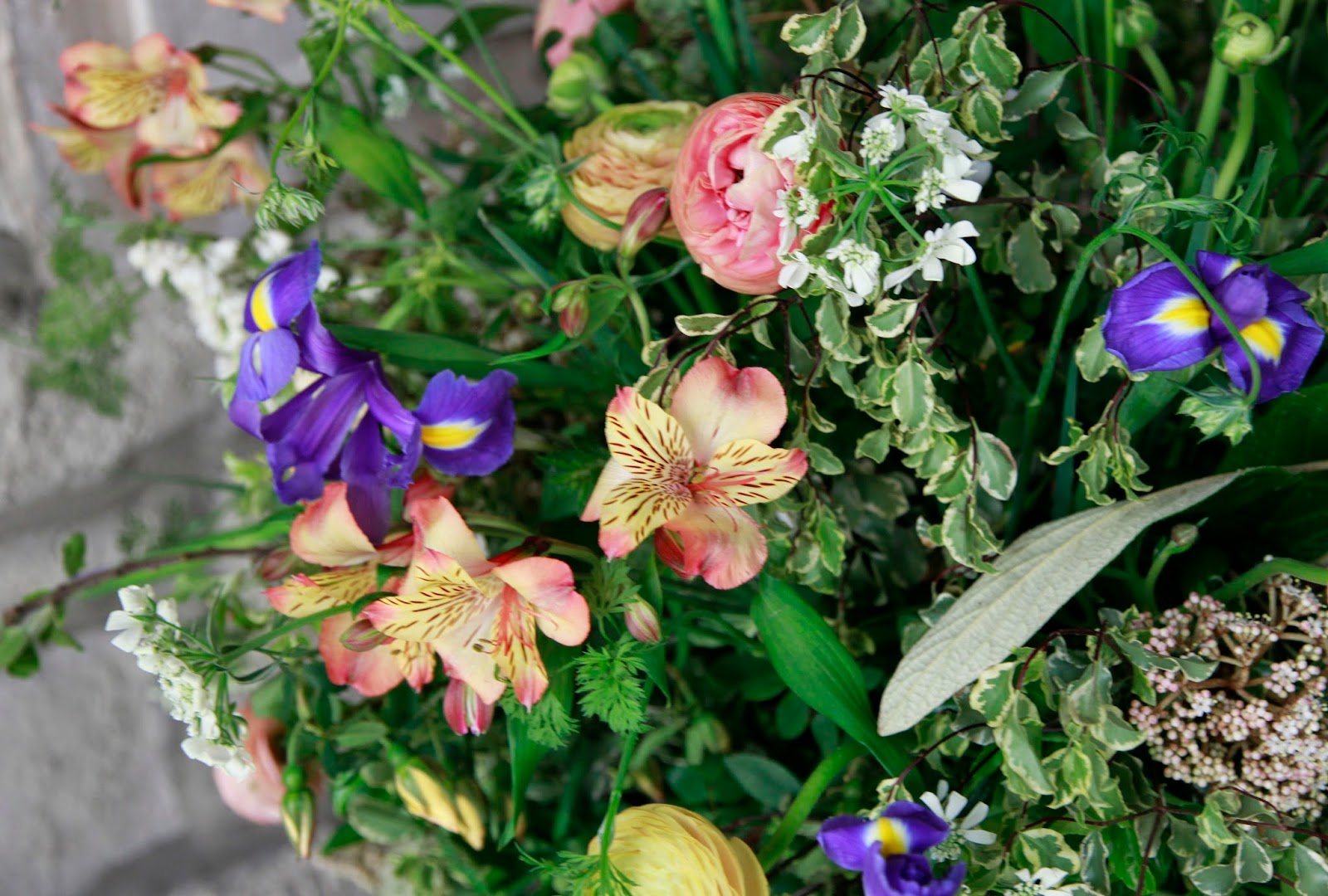
The Flower Union provided beautiful ranunculus in the softest pink and yellow shades, alstromeria, apple blossom, lilac, dainty white orlaya, viburnum, and pittosporum.


The flowers are each so beautiful. And the scent of roses started to fill up the windy porch.


There were a few stems left over, so I made up a little posy of ranunculus and hesperis to sit alongside the cake. The cake is safely hidden away in its box here, but I was given a sneak peak at it - it was a work of art! The mother of the bride had hand-painted birds and flowers all over the tiered cake.


This is the sort of wedding party I adore - family were helping set things up in the morning and it was lovely to meet some of them and to see how special the wedding and their family were to them.


Sunday, 16 November 2014

Tower poppies


I mentioned my South London-centricism in my last post. I think many Londoners, on both sides of the river, suffer from a condition I call world-revolves-around-Londonism. Also known as London arrogance. I'm not talking about the type of arrogance you see when walking through the City during rush hour - that's a whole other kind of awful. I mean the feeling that important things in London will last forever. It's a feeling that was challenged when Canary Wharf was bombed in 1996 - I was in town at the time and was shaken by the thought that such a strong, developing part of this confident city might be vulnerable. It's also a feeling that meant I missed seeing the Nineteen Eighty-Four book bench by Thomas Dowdeswell in the summer; I knew it was a temporary display, but also assumed I had an indefinite amount of time to see it.

It also meant that when I first heard about the Tower poppies, I expected to make several trips to see them, to watch the "field" growing. Did I? No, I didn't. And as Armistice Day drew closer, I found myself busier with work and uni, ill with first a migraine and then a virus, and refusing to go at any time other than dawn. Perhaps it's nothing to do with living in South London for the best part of four decades, and more to do with my own stubbornness.


Last Thursday I returned to work, and thought I would go and see the poppies before my first appointment. I knew they had started to dismantle them the day before, but I also knew that it would take a long time - 888 246 ceramic poppies need much gentle care.


I quickly took a few photos of the view from London Bridge towards Tower Bridge. When I used to work in Essex, I would often walk to Liverpool Street from Cannon Street or London Bridge. The walk from Cannon Street reminded me of Roald Dahl's short story, Galloping Foxley (if you tend to get the same train to work every day, I recommend a read of it). But the walk from London Bridge meant I could see this view in the morning.


I'll never tire of it.


I saw Tower Bridge and City Hall up ahead as I walked along the south side of the river. Tower Bridge is fantastic - it's so colourful and distinctive. I adore City Hall, too. I think it's a beautiful building, and I regret not taking photos of the interior and the view when I got to visit it ten years ago.


I crossed the bridge and saw the poppies gradually and then suddenly.


I realise now why Tower Hill is said to be the best side for viewing - it's nearer to the poppies and at a similar height, whereas the river side has a longer drop down and the poppies are nestled down there.


I walked along the east side and followed the gate to the north side. It was just after 7.15am and it was quiet, except for a few people taking photos and some commuters passing through.


One thing that struck me was the mud. Nearly every book I've read about war, every poem and memoir, describes the mud and the rain, the boredom and the emptiness, as much as the horror and the blood.


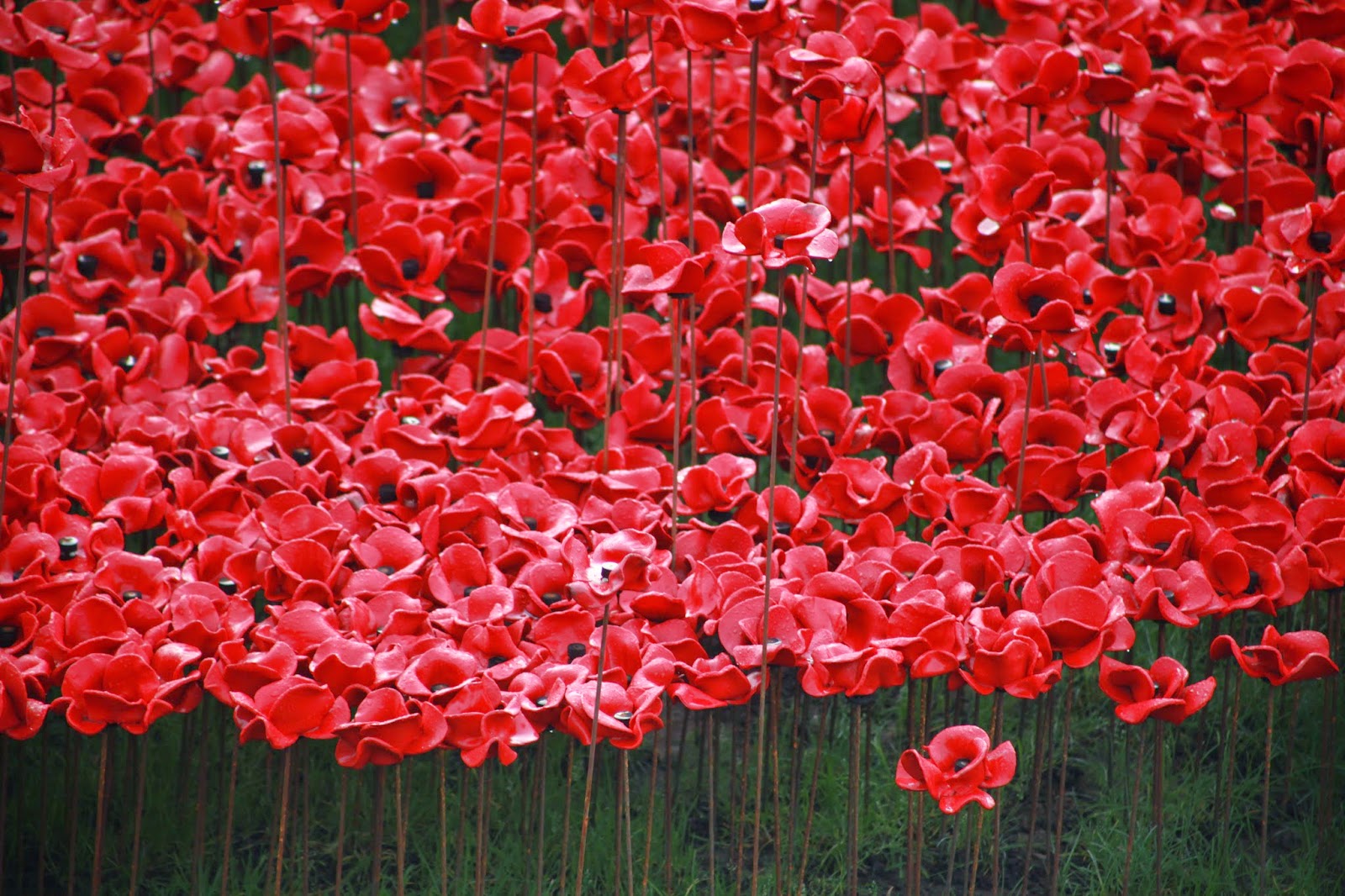
The ceramic poppies were designed by the artist who came up with the idea for the installation, Paul Cummins, and were arranged by stage designer, Tom Piper. 


The official name of the installation is Blood Swept Lands and Seas of Red, and comes from the words of a man who left his home in Derbyshire to join the First World War, but died in Flanders. Each of the 888 246 poppies represents a "British or Colonial military fatality during the First World War". The total number of casualties, according to the Imperial War Museum, was more than 16 million. Cummins said he hoped people visiting the installation would take time to reflect, and although I found it hard to imagine the magnitude of the casualties, I did reflect.


Particularly when I saw them close up.


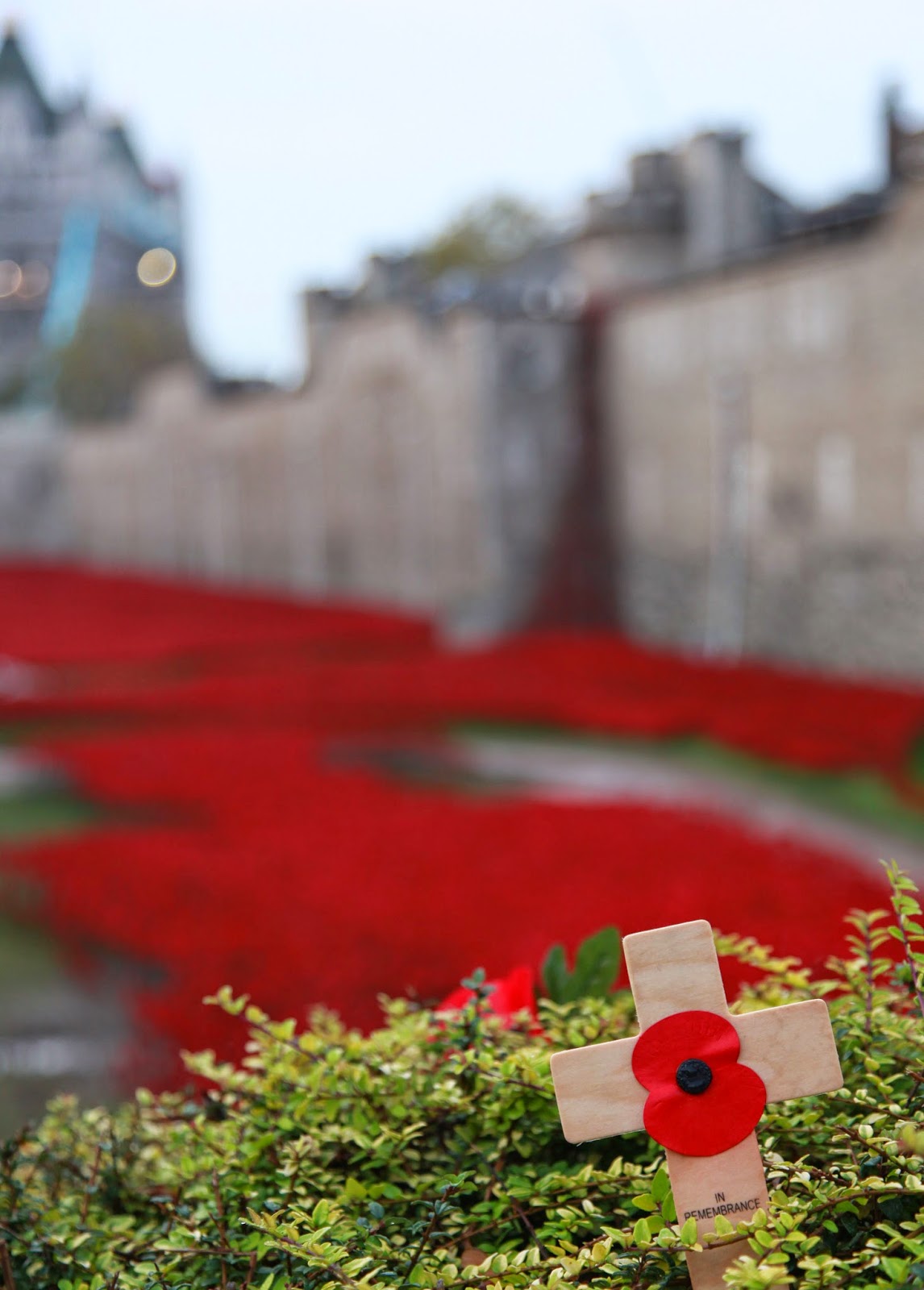
There were several crosses left in tribute around the tower, and I noticed one amongst the poppies.


I was touched by the names, the messages, and the photos.


Ceramic poppies created the sea of red, but there were other flowers to be seen. A yellow rose and a bunch of alstromeria had been tied to the railings, paper and knitted poppies were left nearby, and roses and fuchsia grew around the tower.


Although all of the individual poppies have been sold and will gradually be packed and sent out over the next few months, I think the other poppies that formed part of the installation will go on public display, touring the country.


How wonderful that a part of this display, that caught the hearts and minds of an estimated 5 million people, will be seen by even more.