Showing posts with label Borage. Show all posts

Saturday, 21 March 2015

Floral cupcakes and toxic daffodils


I did some flowers for the Garden Museum's cart, which is part of the museum's stand at the Edible Garden Show at Alexandra Palace this weekend (you can still buy tickets for tomorrow!). I bought some edible (if they are grown organically) flowers from Alagar at New Covent Garden Market, to mix with the herbs and bulbs that are in the museum's cutting garden.


I learnt yesterday, during Jonathon Moseley's weekly #flowertalk hour, that tulips petals are edible. Unfortunately, the tulips in the cutting garden are not ready yet, but there are loads of daffodils. Daffodils are definitely not edible - apparently, some people have been getting them mixed up with spring onions as they are often sold in the same section in supermarkets. Don't mix them up! But as the flowers are so seasonal and there is an abundance right now, it didn't seem right to leave them out of the display.

I wanted to make some rosemary bowls to use as bases for a couple of arrangements. I reused two plastic plant bowls and reused floral foam (cutting out the horrible bits and turning it upside down), cutting the foam into a rounded shape and taping it in place. Then I covered the two bowls with rosemary. There is loads of it in the cutting garden, and it's certainly edible - the staff in the Garden Cafe use the herbs in their cooking. I stuck double-sided tape around each plant bowl, and then placed a large rubber band around the centre. I cut the rosemary into similar-sized lengths that just came higher than the bowl, and added them close together around the bowl, using the rubber band to keep them in place. Once the bowls were covered in rosemary, I tied raffia (again reused) around the centres to cover the elastic bands.


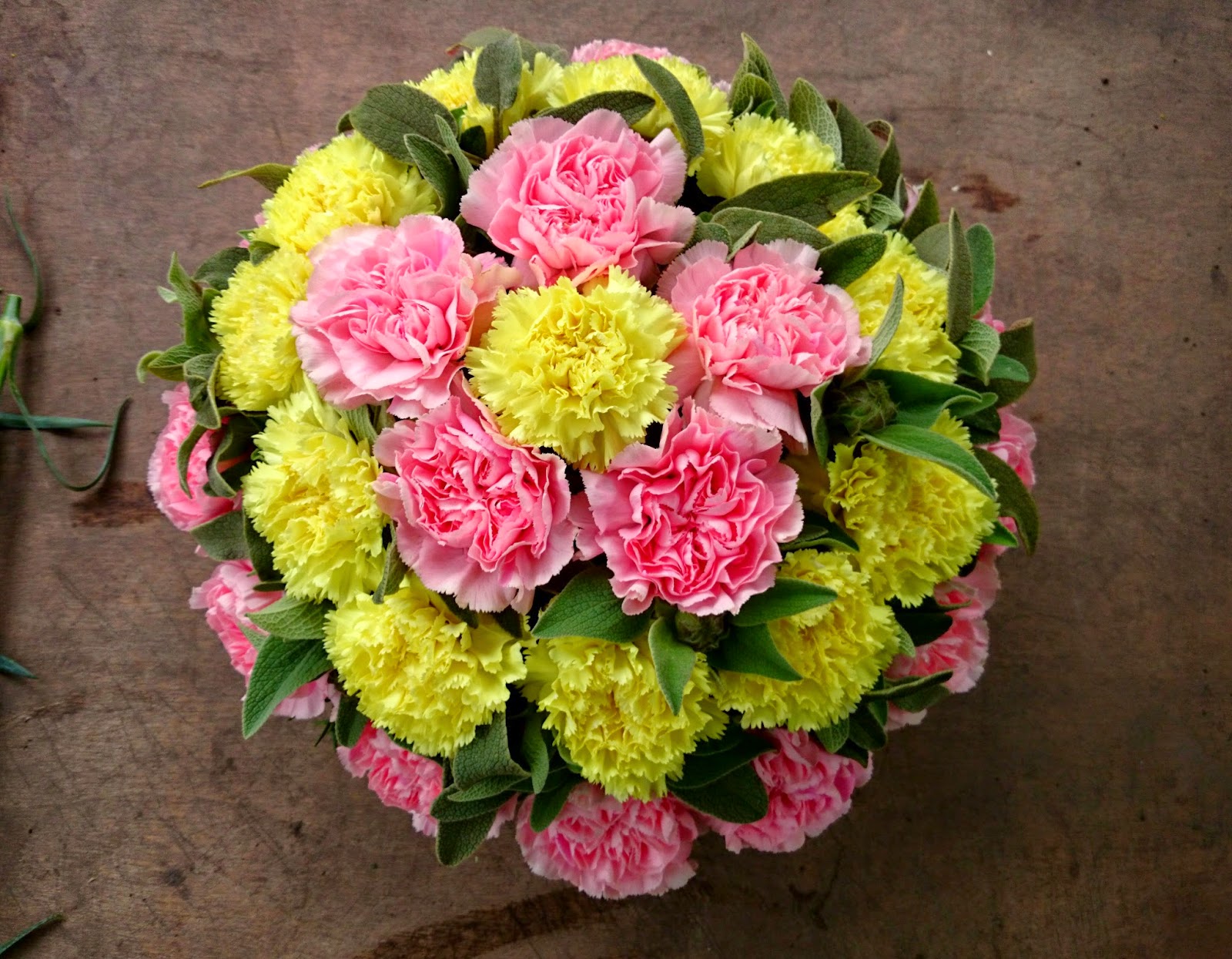
I left one looking quite green and natural, with lots of edible sage and lavender from the cutting garden, and a few inedible daffodils. For the other, I wanted to make a giant cupcake, so I used layers of pink and yellow carnations (which would be edible and scented if grown organically!) and more sage.


I had been saving carefully broken eggshells (using a knife along the very top, rather than tapping the egg on its side) with the intention of making a "bird's nest" planted arrangement as Isabelle Palmer does in her wonderful book The Balcony Gardener. But I didn't trust myself to a) plant up the eggshells without breaking them or b) plant plants that would actually survive the week! So lovely gardener Liz at the Garden Museum took them off my hands and returned them filled with wild strawberry plants.


Liz wasn't due to work on Thursday morning, when I was getting the flowers ready in the museum's knot garden, but she happened to walk past and see me, and decided to join me and help. She found me some violas (more edible flowers) and some mixed planted gifts that she had made up earlier. She also cleared out the flower cart so I could fill it with the new flower display. She also found me a flowering herb called cardamine that I had never heard of before, but whose delicate pink flowers grace the garden in front of the museum.


I crumpled some chicken wire into two metal buckets and threaded lilac, quince blossom, the stems of the poor beheaded carnations, and a few leftover carnations into the gaps.


And I made a few posies with daffodils (definitely toxic), snowflakes (also toxic, I suspect), and edible lavender, rosemary, sage, and cardamine (the leaves are edible, I think).


You can buy edible flowers from here and here - which is the safest bet if you aren't sure whether something is edible or how it was grown! Later in the year, there are lots of edible flowers, from roses to borage to lavender flowers. Another reason to look forward to the summer.


Friday, 15 August 2014

What's your type?


Romantic? There were so many pink, blousy roses, they were perfect for a romantic, fluffy bouquet, with white scented phlox, pink and white cleome, floaty white ammi, and fairy dust-like panicum.


Old-fashioned? Peach and pink roses, mixed with lavender, borage and orange thyme, made for a old-fashioned, scented posy.


Opposites attract? I love the combination of cerise and lime green. Nicotiana 'Lime Green' has proved to be a brilliant cut flower, and the plants do well indoors too, releasing their gorgeous scent at night. These were leftovers which were used to brighten up the bathroom - a room that I never would have considered decorating with flowers until I read Jane Packer's wonderful book, At Home with Flowers! The other flowers are Cosmos 'Sensation', Zinnia 'Purple Prince', cornflowers and sweet-smelling sweet peas.


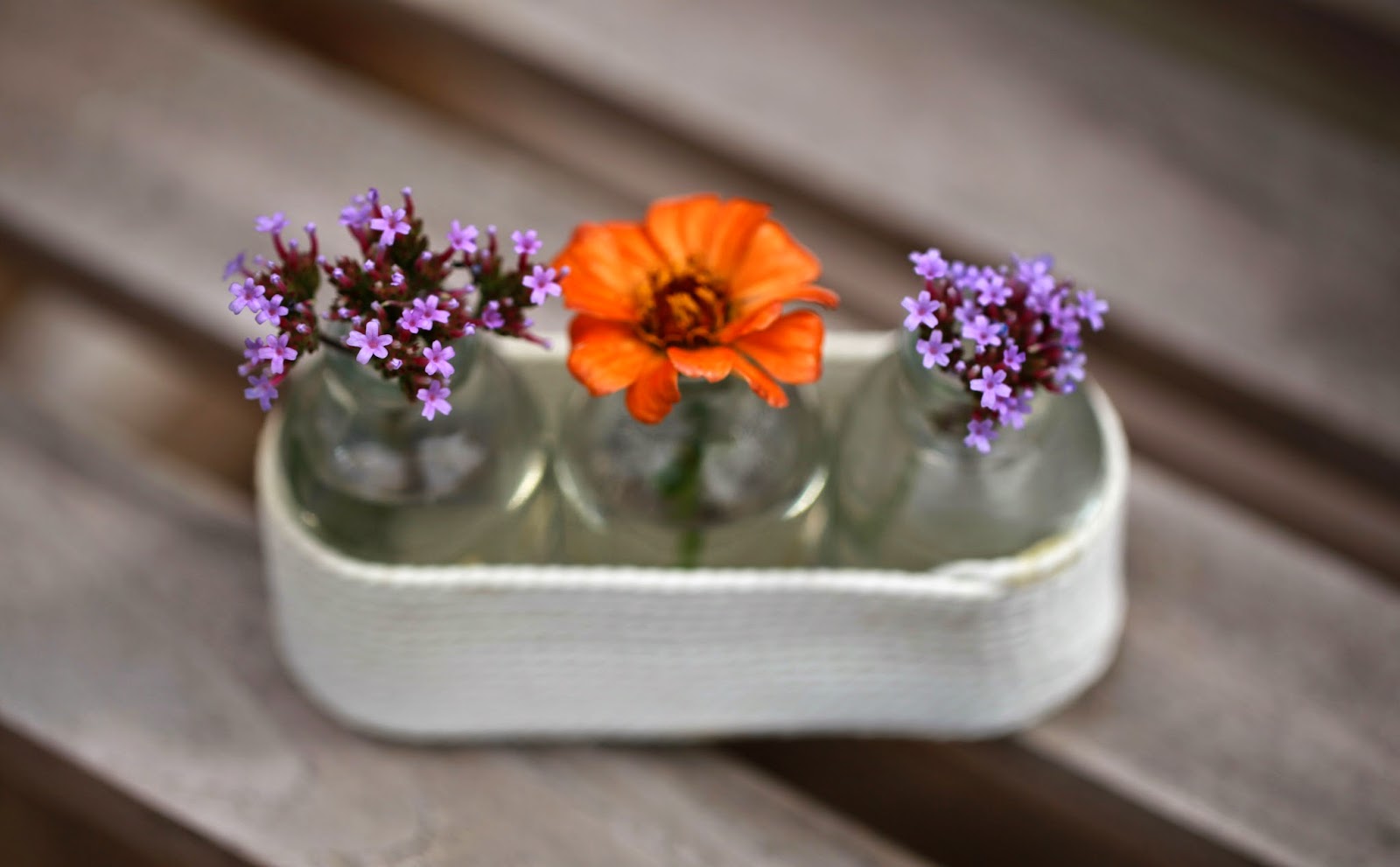
Scatty Scarlett? The late Charlotte Coleman played Scarlett in Four Weddings and a Funeral, wearing an outfit that Gareth (Simon Callow) described as "ecclesiastical purple and the pagan orange symbolizing the mystical symbiosis in marriage between the heathen and Christian traditions." Nothing so philosophical was going on here; I just wanted to show Ben "Higgledy Garden" (who provided my borage and nicotiana seeds) that girls like purple and orange flowers too! These were verbena bonariensis and an orange zinnia.


Neighbourly? Pink, purple and blue sit next to each other on the colour wheel, and are one of my favourite colour combinations. Here are pink zinnias from the mixture of 'Early Wonder' colours, purple verbena, and blue borage.

As you've probably gathered, I don't really have a type. Although if I had to choose, I'd go for scented and old-fashioned. I like lots of different combinations of flowers - sometimes I don't know what works and what doesn't until I put them together. 

Pick flowers from the garden, or get bunches from the florist, and try putting them together in different ways. If you don't think you have a good eye for colour, this lopsided colour wheel might help. I had to create it for a floristry assignment when I did my diploma...I'm shuddering at the memory! The true colour or hue is on the outside ring, followed by the tint (hue+white), the shade (hue+black), and the tone (hue+grey).


Monday, 11 August 2014

Basil and borage


This is a photo of some basil ice cream I made last week and borage iced-water. Yes, really - ice cream made with basil. I saw that Sarah Raven had posted a recipe for it, and I thought I would make it, since I've been growing basil but don't enjoy cooking. Basil ice cream does sound odd, but then mint chocolate ice cream is well established (I once saw a little boy cry, "But I wanted mint chocolate!" when he was mistakenly given chocolate ice cream at Marrocco's in Hove). Basil isn't so very different from mint, is it? Although in flower language, mint means "warmth" and basil means "hate" - which is why I never use basil in arrangements.


I've never made ice cream before and I don't have a churner, or common sense. I used a liquidiser to blend the ingredients, and probably should have used an electric mixer instead. But I took it out and mixed it after an hour in the freezer, and after another couple of hours it was ice cream. And it was delicious - honestly! I used a quarter of the recipe; I don't entertain much and ice cream isn't exactly the sort of thing I can take to a friend's on overheated London trains.


I've also been making borage ice cubes, which gives water a lovely cucumber taste. I think borage is the most versatile flower I've grown - it looks great in arrangements, the bees love it, it's edible, and it looks pretty decorating food. If you've never used it, consider growing it next year. I got my seeds from Higgledy Garden. I have so many borage plants, I gave some to a friend who needs to attract bees to her garden for some of her vegetables to fruit.


And those of you who are still unsure about using basil in ice cream may be relieved to know that I used homegrown basil, tomatoes and a red pepper to make soup. Does that sound a bit better?


Sunday, 3 August 2014

Rosewater and borage biscuits


Some of my experimental baking is intentional (the lime and ginger cake below, for example, where I didn't realise the lime would completely overpower the ginger), and some is accidental. The rosewater biscuits I made this week were a mixture of both.


I intended to make rosewater biscuits for my friend Sarah, as she loved the rosewater jam tarts I'd made before. And I thought I'd try to crystallise some borage to decorate them - the flavours might not go well, but at least they'd look pretty.

I used Peggy Porschen's vanilla biscuit recipe from the book Cake Chic, and deliberately added 1 tsp of rosewater as well as a little vanilla extract. But I ran out of plain flour after 250g, so I topped up with 150g self-raising flour. The dough was wetter than other biscuit doughs I'm used to, but I thought that might be the liquid of the flavouring (Peggy uses drier flavourings for her biscuits - vanilla pod seeds, zest or cocoa powder).

Anyhow. After it had chilled for an hour, I rolled it out, cut some sensible shapes for my friend and some rabbits for me, and baked them. There was a lot of dough, so I froze two "logs" of it, so I can easily take out, slice and bake another time.

The half-risen rosewater biscuits seemed nice to me! Maybe the self-raising flour meant they were softer, I don't know - I've never understood the science of baking. I'm only doing it for pleasure, so I can afford to make mistakes!

When they'd cooled down, I iced a few of them with "Grape violet" coloured royal icing, added the few crystallised borage flowers that hadn't gone all gooey, and used the stencils that Sarah gave me for my birthday last year to add some blue sugar dust. The rest I kept plain for me.


Saturday, 2 August 2014

A floral photography lesson from Amo La Fotografia


One thing I found difficult last year when I started learning how to use a photographer's camera and lenses (rather than my usual point-and-click or my mobile phone), was how to photograph white and pale flowers, especially when mixed with darker flowers. In this posy, the white roses lost their beautiful definition in my photos and just looked like big balls of white light!

So I was delighted when the lovely Kent-based photographer, Karen Louise of Amo La Fotografia, offered to give me an online lesson in photographing white flowers, along with other tips to improve flower photography indoors and outside. The ISO needs to be a low number (e.g. 100), the F-stop depends on whether you want detail in the background as well as the subject - a lower number for less detail in the background, and a faster shutter speed will result in a less exposed (light) photo. I am used to using the histogram as a guide, not the shutter speed, so this was all new to me. But...it works! It's quite hard to get out of old habits, and I can see that many of my photos could improve if I were a bit braver. As Karen Louise says in her tutorial, it's easier to 'correct' underexposed (darker) photos with an editing tool than it is to correct overexposed (lighter) photos. And incidentally, when you look at her tutorial you'll see her flower arrangements are as gorgeous as her photos!

Here are some photos I took of a couple of "all in the garden" arrangements, after reading the lesson. I'm a bit annoyed by the 'Penny Lane' dahlia sticking out like a sore thumb in the middle of the big arrangement - I actually removed it at the last minute before it was delivered - but never mind. The huge heads of white phlox are what I was worried about photographing, but I love how the detail  is kept by using a faster shutter speed. The tiny white flowers of Moroccan mint (I used lavender, orange, and pineapple varieties too) also kept their detail, and the white and red flowers of the 'Hot Lips' salvia kept more detail than usual. And you can't photograph scent, unfortunately, but both arrangements were highly scented, thanks to the wonderful phlox, mints, lemon balm/Melissa, sage, nicotiana, and sweet peas.


Sunday, 27 July 2014

Three thunderstorms and a heatwave


The hot weather has encouraged a lot of flowers to whoosh ahead and open quickly. But the first thunderstorm was a bit of a shock - I don't ever remember a storm being so loud and going on for such a long time. I certainly was not one of the people who went outside to catch a photo of the lightning! Despite the lashing rain and hailstones (hailstones in a heatwave - how does that work?!), my flowers survived.


There were lots of new flowers to enjoy - I started to cut the borage, and before long there was cleome, cosmos and ammi. I used some this weekend - but I'll save that for another post. I planted out some cleome and panicum - they look great together. Both are such explosive, unusual textures.


It's a much better year for my flowers than 2013, when I certainly didn't have enough for orders or gifts, except the occasional small posy. This year, when I cut from the garden, I usually fill several buckets - it's wonderful. Stems have been much longer this year too, which means I can used them for handtieds and big arrangements, not just small posies and short-stemmed funeral work. The phlox and 'Penny Lane' dahlias are a metre tall, the verbena a metre and a half, and the zinnias and cosmos are 85cm!


The spring-sown 'Polka Dot' cornflowers are quite short and soft-stemmed, but that's ok - I know to nurture my autumn-sown ones better in future! And anyway, they still look beautiful.


I've done a few handtieds similar to this one.


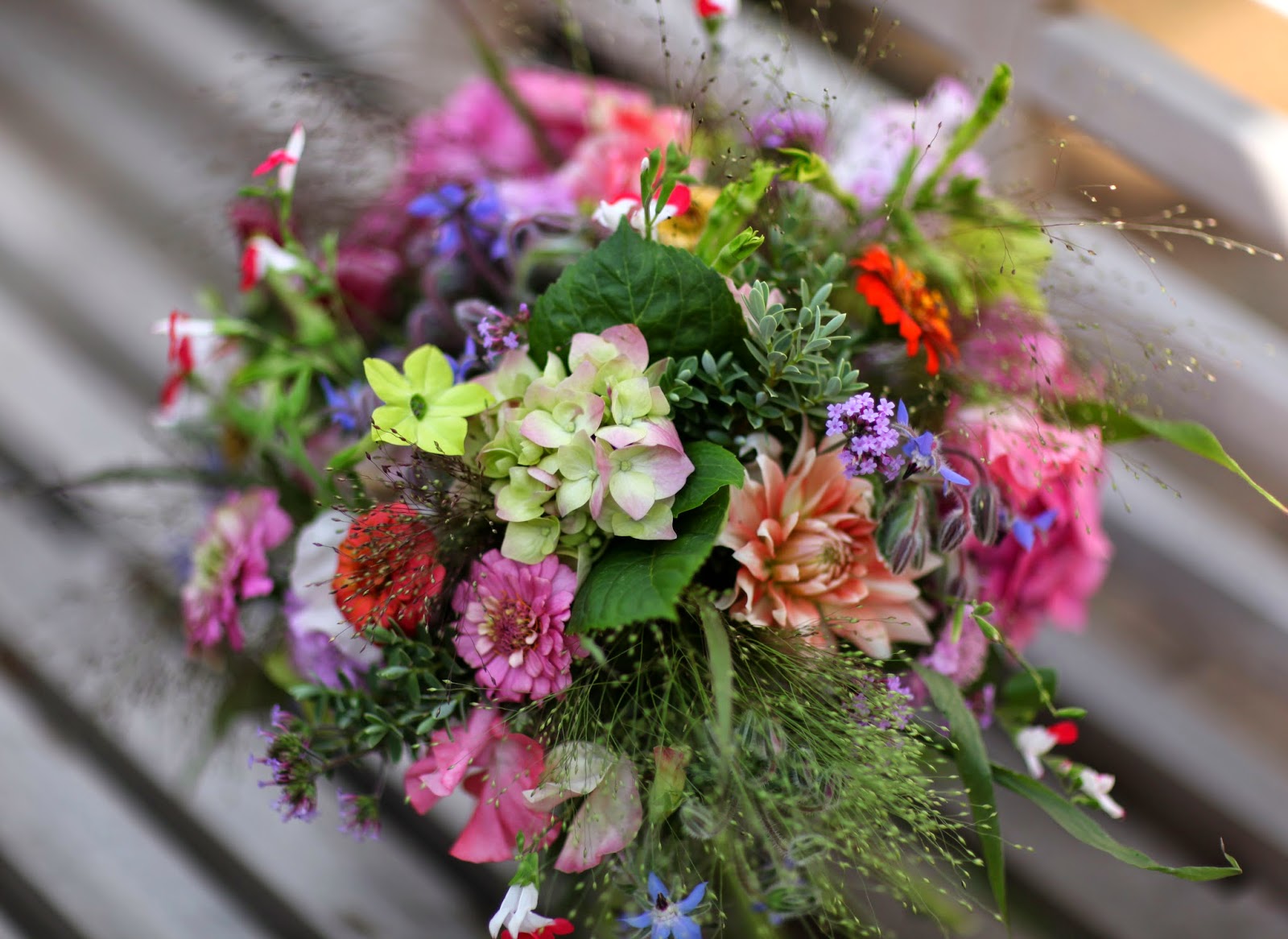
It uses borage, Nicotiana 'Lime Green', Panicum 'Frosted Explosion', Zinnia 'Early Wonder', Salvia 'Hot Lips', sweet peas ('Harlequin Mixed', 'Leominster Boy' and 'Dot Com'), hebe, hydrangea, verbena bonariensis, Scabious 'Pink Mist', and a 'Penny Lane' dahlia. That's one of the great things about using a garden or flower farm - you can have fewer stems each of a wider range of flowers and foliage, rather than wraps and boxes of the same species and variety.


I was asked to do casual, colourful flowers for a family gathering - so I did this grouping in Portmeirion Botanic Garden vases and bowls, a Dartington Little Gems vase, a La Mortuacienne bottle, and a tiny green bud vase. I took these photos in a hurry as I heard thunder rumbling in the distance! I quickly took everything indoors and photographed the Portmeirion pieces together.


The roses are back! I used a few to make this red, white and peach posy, and I cut a few 'Jude the Obscure' David Austin roses for their incredible scent. Mixed with flowering Moroccan mint, salvia, phlox and nicotiana, these were two sweet-smelling additions to the group.


Monday, 7 July 2014

Firework flowers


Lots of things are flowering or about to flower now - Nicotiana 'Lime Green' and borage (from Higgledy), Panicum 'Frosted Explosion' and spring-sown cornflowers (from Sarah Raven's), zinnias, jasmine, sweet peas, roses and phlox. The panicum above and below looks like fireworks or fairies, depending on whether you prefer fairytales or Guy Fawkes' Night.


Sweet peas and roses fill rooms and gardens with scent in the day, but nicotiana and jasmine release their scent at night. Early in the morning, you can smell all of them.


I caved in and cut some panicum and nicotiana, but I'm holding out a bit longer for the beautiful blue borage, phlox and Jude the Obscure roses (which I thought would never flower this year!). 


I love the lime green of the nicotiana - it's the perfect partner for bright zinnias and sweet peas.