Sunday, 3 August 2014

Wildflower meadow in Preston Park


Last year I noticed colourful wildflowers on a drive past Preston Park (Brighton), but didn't have time to go back and see them properly. This year, I made a special trip. I visited my sister and we got the bus to Preston Park. The park has a lovely rose garden at one end, near to the cafe.


The wildflower meadow is nearby. Two unused bowling greens were transformed by council workers and volunteers last year, and it looks fantastic. We went at the end of July, so it should be looking good for another month or two.


Rosewater and borage biscuits


Some of my experimental baking is intentional (the lime and ginger cake below, for example, where I didn't realise the lime would completely overpower the ginger), and some is accidental. The rosewater biscuits I made this week were a mixture of both.

I intended to make rosewater biscuits for my friend Sarah, as she loved the rosewater jam tarts I'd made before. And I thought I'd try to crystallise some borage to decorate them - the flavours might not go well, but at least they'd look pretty.

I used Peggy Porschen's vanilla biscuit recipe from the book Cake Chic, and deliberately added 1 tsp of rosewater as well as a little vanilla extract. But I ran out of plain flour after 250g, so I topped up with 150g self-raising flour. The dough was wetter than other biscuit doughs I'm used to, but I thought that might be the liquid of the flavouring (Peggy uses drier flavourings for her biscuits - vanilla pod seeds, zest or cocoa powder).

Anyhow. After it had chilled for an hour, I rolled it out, cut some sensible shapes for my friend and some rabbits for me, and baked them. There was a lot of dough, so I froze two "logs" of it, so I can easily take out, slice and bake another time.

The half-risen rosewater biscuits seemed nice to me! Maybe the self-raising flour meant they were softer, I don't know - I've never understood the science of baking. I'm only doing it for pleasure, so I can afford to make mistakes!

When they'd cooled down, I iced a few of them with "Grape violet" coloured royal icing, added the few crystallised borage flowers that hadn't gone all gooey, and used the stencils that Sarah gave me for my birthday last year to add some blue sugar dust. The rest I kept plain for me.


Saturday, 2 August 2014

A floral photography lesson from Amo La Fotografia


One thing I found difficult last year when I started learning how to use a photographer's camera and lenses (rather than my usual point-and-click or my mobile phone), was how to photograph white and pale flowers, especially when mixed with darker flowers. In this posy, the white roses lost their beautiful definition in my photos and just looked like big balls of white light!

So I was delighted when the lovely Kent-based photographer, Karen Louise of Amo La Fotografia, offered to give me an online lesson in photographing white flowers, along with other tips to improve flower photography indoors and outside. The ISO needs to be a low number (e.g. 100), the F-stop depends on whether you want detail in the background as well as the subject - a lower number for less detail in the background, and a faster shutter speed will result in a less exposed (light) photo. I am used to using the histogram as a guide, not the shutter speed, so this was all new to me. But...it works! It's quite hard to get out of old habits, and I can see that many of my photos could improve if I were a bit braver. As Karen Louise says in her tutorial, it's easier to 'correct' underexposed (darker) photos with an editing tool than it is to correct overexposed (lighter) photos. And incidentally, when you look at her tutorial you'll see her flower arrangements are as gorgeous as her photos!

Here are some photos I took of a couple of "all in the garden" arrangements, after reading the lesson. I'm a bit annoyed by the 'Penny Lane' dahlia sticking out like a sore thumb in the middle of the big arrangement - I actually removed it at the last minute before it was delivered - but never mind. The huge heads of white phlox are what I was worried about photographing, but I love how the detail  is kept by using a faster shutter speed. The tiny white flowers of Moroccan mint (I used lavender, orange, and pineapple varieties too) also kept their detail, and the white and red flowers of the 'Hot Lips' salvia kept more detail than usual. And you can't photograph scent, unfortunately, but both arrangements were highly scented, thanks to the wonderful phlox, mints, lemon balm/Melissa, sage, nicotiana, and sweet peas.


Sunday, 27 July 2014

Three thunderstorms and a heatwave


The hot weather has encouraged a lot of flowers to whoosh ahead and open quickly. But the first thunderstorm was a bit of a shock - I don't ever remember a storm being so loud and going on for such a long time. I certainly was not one of the people who went outside to catch a photo of the lightning! Despite the lashing rain and hailstones (hailstones in a heatwave - how does that work?!), my flowers survived.


There were lots of new flowers to enjoy - I started to cut the borage, and before long there was cleome, cosmos and ammi. I used some this weekend - but I'll save that for another post. I planted out some cleome and panicum - they look great together. Both are such explosive, unusual textures.


It's a much better year for my flowers than 2013, when I certainly didn't have enough for orders or gifts, except the occasional small posy. This year, when I cut from the garden, I usually fill several buckets - it's wonderful. Stems have been much longer this year too, which means I can used them for handtieds and big arrangements, not just small posies and short-stemmed funeral work. The phlox and 'Penny Lane' dahlias are a metre tall, the verbena a metre and a half, and the zinnias and cosmos are 85cm!


The spring-sown 'Polka Dot' cornflowers are quite short and soft-stemmed, but that's ok - I know to nurture my autumn-sown ones better in future! And anyway, they still look beautiful.


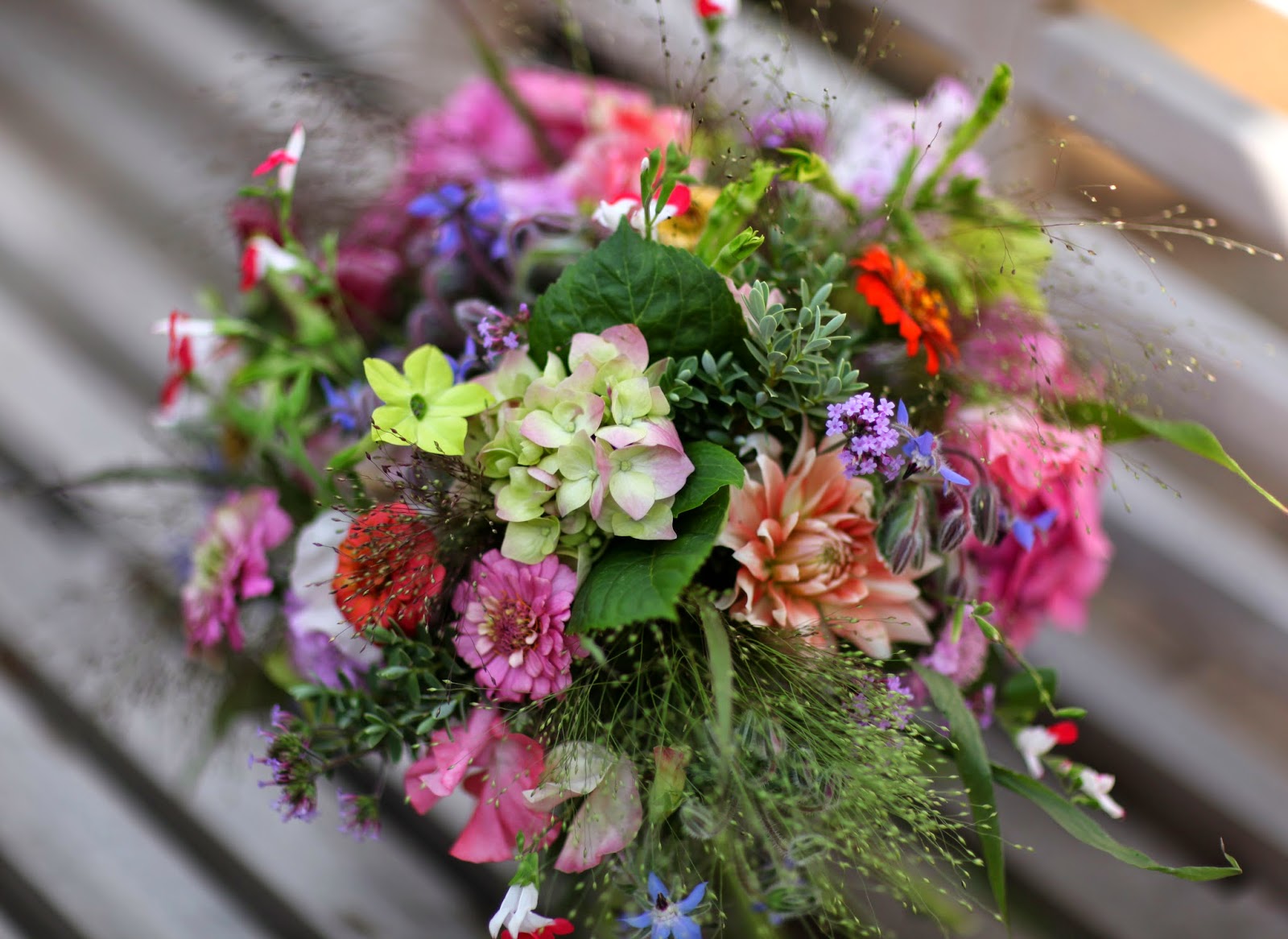
I've done a few handtieds similar to this one.


It uses borage, Nicotiana 'Lime Green', Panicum 'Frosted Explosion', Zinnia 'Early Wonder', Salvia 'Hot Lips', sweet peas ('Harlequin Mixed', 'Leominster Boy' and 'Dot Com'), hebe, hydrangea, verbena bonariensis, Scabious 'Pink Mist', and a 'Penny Lane' dahlia. That's one of the great things about using a garden or flower farm - you can have fewer stems each of a wider range of flowers and foliage, rather than wraps and boxes of the same species and variety.


I was asked to do casual, colourful flowers for a family gathering - so I did this grouping in Portmeirion Botanic Garden vases and bowls, a Dartington Little Gems vase, a La Mortuacienne bottle, and a tiny green bud vase. I took these photos in a hurry as I heard thunder rumbling in the distance! I quickly took everything indoors and photographed the Portmeirion pieces together.


The roses are back! I used a few to make this red, white and peach posy, and I cut a few 'Jude the Obscure' David Austin roses for their incredible scent. Mixed with flowering Moroccan mint, salvia, phlox and nicotiana, these were two sweet-smelling additions to the group.


Sunday, 20 July 2014

RHS Hampton Court Flower Show 2014: Deadly sins

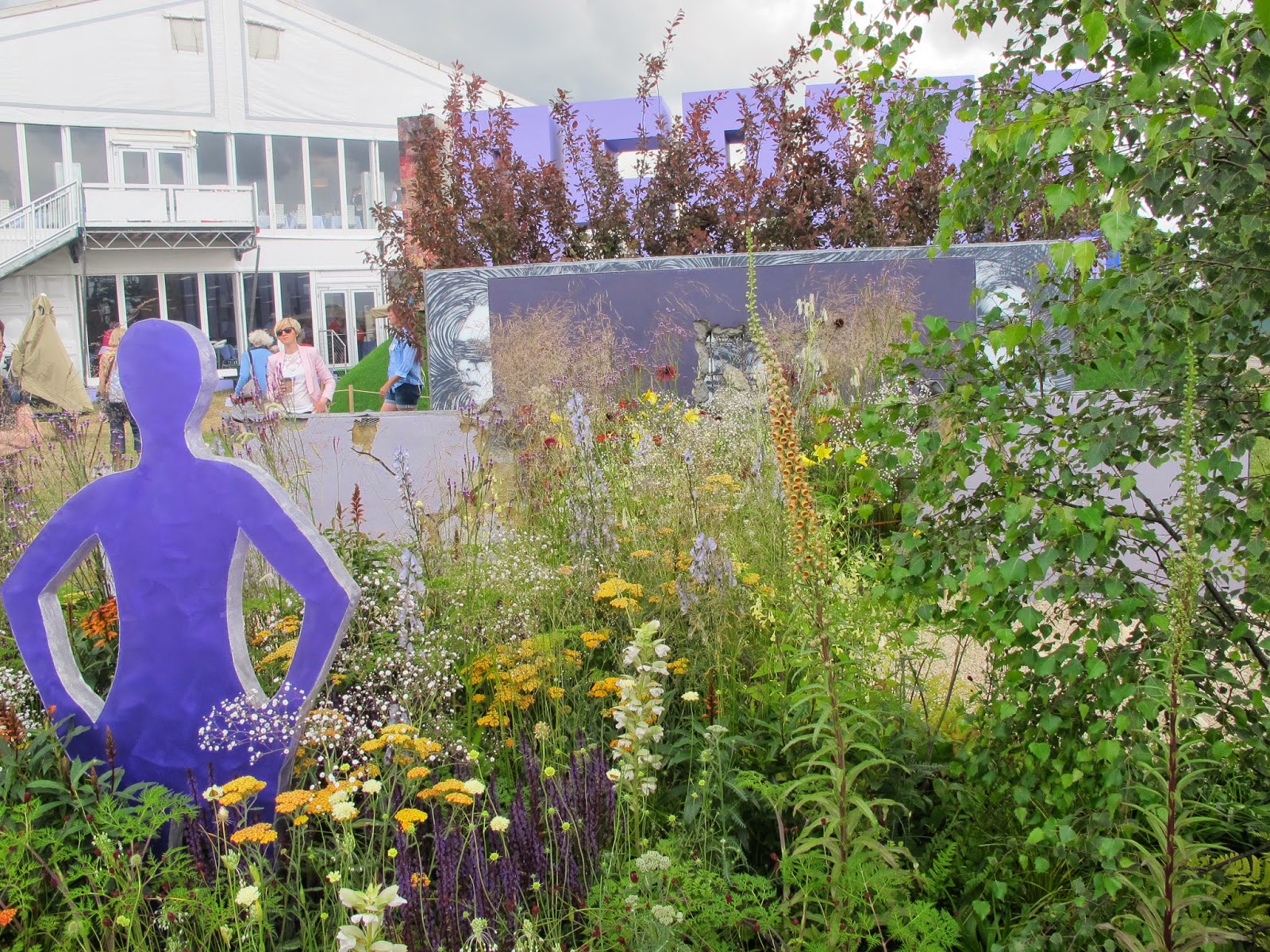
The conceptual gardens at this year's show were all themed on the idea of the seven deadly sins. The first thing I saw when I walked in was Sheena Seeks' garden "Sloth: Quarry of Silences". It won a gold medal and best conceptual garden.


Each tool was different and represented a person. There was a huge golden rock at the top (each person's goal), but if you went around to the back, you could see that there were three graves to fall into, representing the mind, body, and soul.


There didn't seem to be as much planting as I'd have liked, but I did like the wild landscape around the quarry.


Then there was "Lust", designed by Rachel Parker Soden. It won a silver medal, but I think it deserved better.


As you walked through the garden, you peeped into the glasshouse. There was a red sofa, exotic red and peachy flowers such as gloriosa lilies, anthuriums and orchids, and a red neon sign that said "Peep Show" at the front (and "Live Show" at the back). I loved it - it reminded me of two things I adore: Marion and Ted's secret relationship in The Go-Between, and the sit-com Peep Show. Even Sam Bain, who writes Peep Show with Jesse Armstrong, appreciated the "Lust" garden's sofa.


The planting outside was beautiful. There were roses in pretty pinks and passionate reds, dark brown chocolate cosmos, red and pink achillea, and tactile plants including fluffy grasses and delicate ammi. There were also succulents, kniphofia, and a river with a crossing.


A brilliant conceptual garden was "Pride - The Stonewall Garden: Breaking Down the Barriers" which got a well-deserved gold. Designed by Amanda Miller, it was inspired by her troubles growing up as a gay teenager in a small town in Australia.


I thought the smashed wall, and the black and white painting at the back were powerful images.


The garden itself was beautiful, with gorgeous, colourful planting.


Katerina Rafaj created a Pop Art style garden called "Gluttony: E123", showing the excesses of food consumed and discarded in some countries. It won a gold medal for its Andy Warhol-style tins of food, giant jelly beans, and the planting which included roses, and a pond in a sardine tin.


A conceptual garden that really drew the crowds was "Wrath: The Eruption of Unhealed Anger". It won a gold for designer Nilufer Danis. Inspired by volcanoes, with occasional eruptions of smoke or water, it was a fantastic garden to take in all at once. The stunning red echinacea, yellow kniphofia, and orange achillea looked amazing, and certainly evoked strong emotions. As a trainee counsellor as well as a florist, I enjoyed this garden a great deal - the idea of quiet anger simmering away and then erupting is a powerful one that was well executed here.


A silver-gilt winner was "Greed: Dichotomy Garden" by Sara Jane Rothwell and JoanMa Roig. It was a garden in two parts, and as such, I couldn't really connect with it. One side was supposed to be the judge's garden with neat box hedging and a throne, and the other was wilder as a result of the "sinner's greed". There was a wall with a small mesh partition to see into the other side of the garden.


The "Envy: The Grass is Always Greener" garden was inspired by the idiom "The grass is always greener on the other side" and won a silver medal for the designer Marcus Green. I couldn't see inside the green Perspex box (apparently it housed an artificial lawn), but I did love the grasses growing outside it.


I love the texture and movement of grasses - there's something quite primal and childhood-evoking about them - so I took several photos of grasses at the show. Partly for my own enjoyment, and partly for Sara Willman of My Flower Patch, who loves grasses too.