Saturday, 6 July 2013

Here, there, every pear

This is a post about two orchards; one in the heart of London and the other in the heart of Kent. I came across them both, unexpectedly, in the same week.

I'll talk about the second orchard first. I stumbled across Octavia’s Orchard in front of the Nelson Mandela statue on the South Bank in London. I had spent a lovely afternoon talking to artist Gemma Seltzer, walking along the river, photographing the Body Gossip flash mob and reading their messages of love for their bodies. Then I came across two things. The first was the Queen’s Park Walk Gardens. More of that later. And then, after that pretty treat, I turned a corner and saw this:
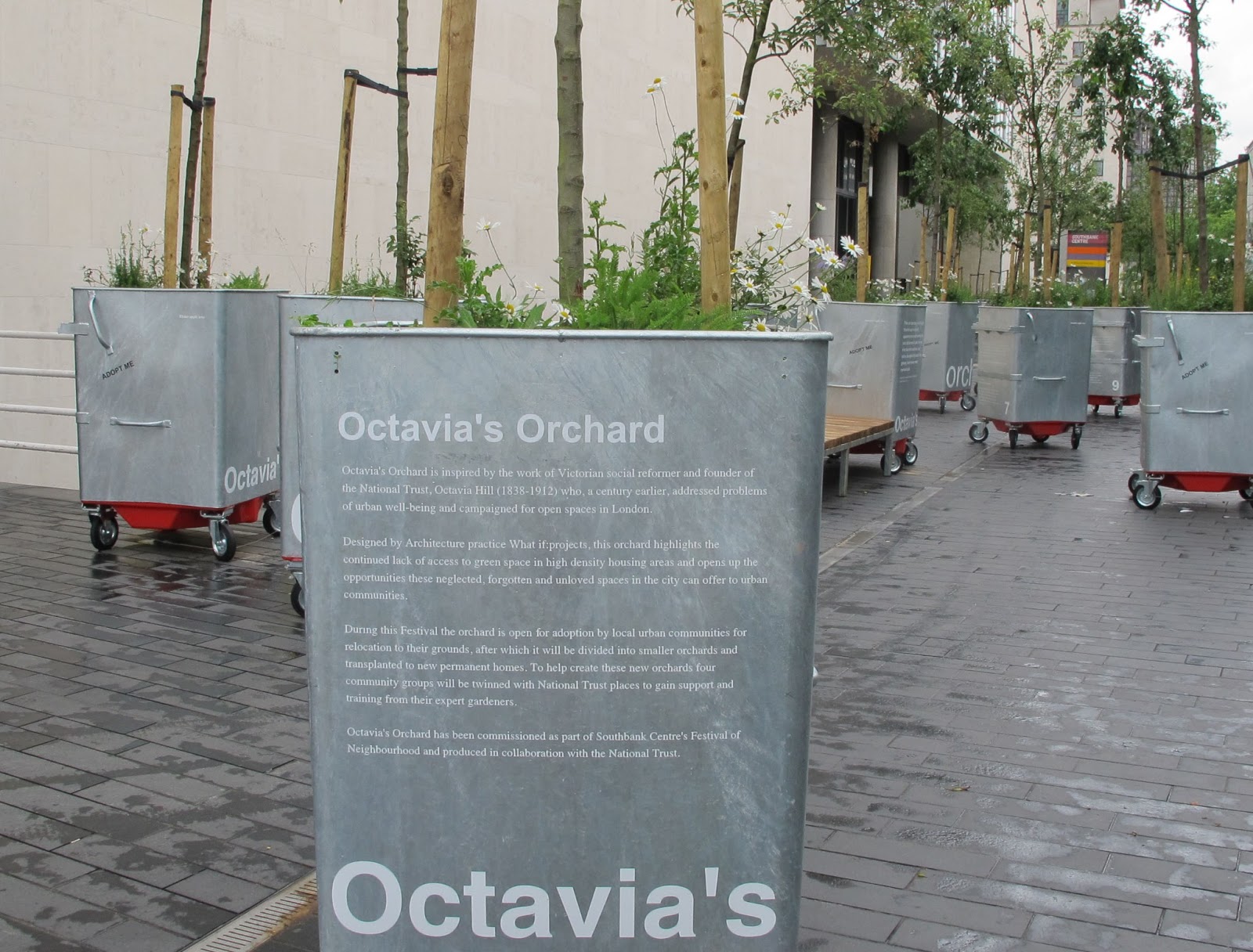

What a marvellous sight. I walked around, learning about Octavia Hill, who founded The National Trust, and reading some great quotes. Including these:


The trees which are being grown in these giant steel wheelie bins are Cox’s Orange Pippin, James Grieve, Elstar, Bramley and Jonagold apple trees, as well Victoria Plum and Beurre Hardy Pear.


There are flowers planted around each tree, which makes them even prettier and more of an anomaly in Central London. This urban orchard will be there until Sunday 8th September, as part of the South Bank’s Festival of Neighbourhood.

The greatest tree for me was this one, as you could see Mandela in the background, and the quote seemed particularly poignant. As I write this, he is still in hospital.


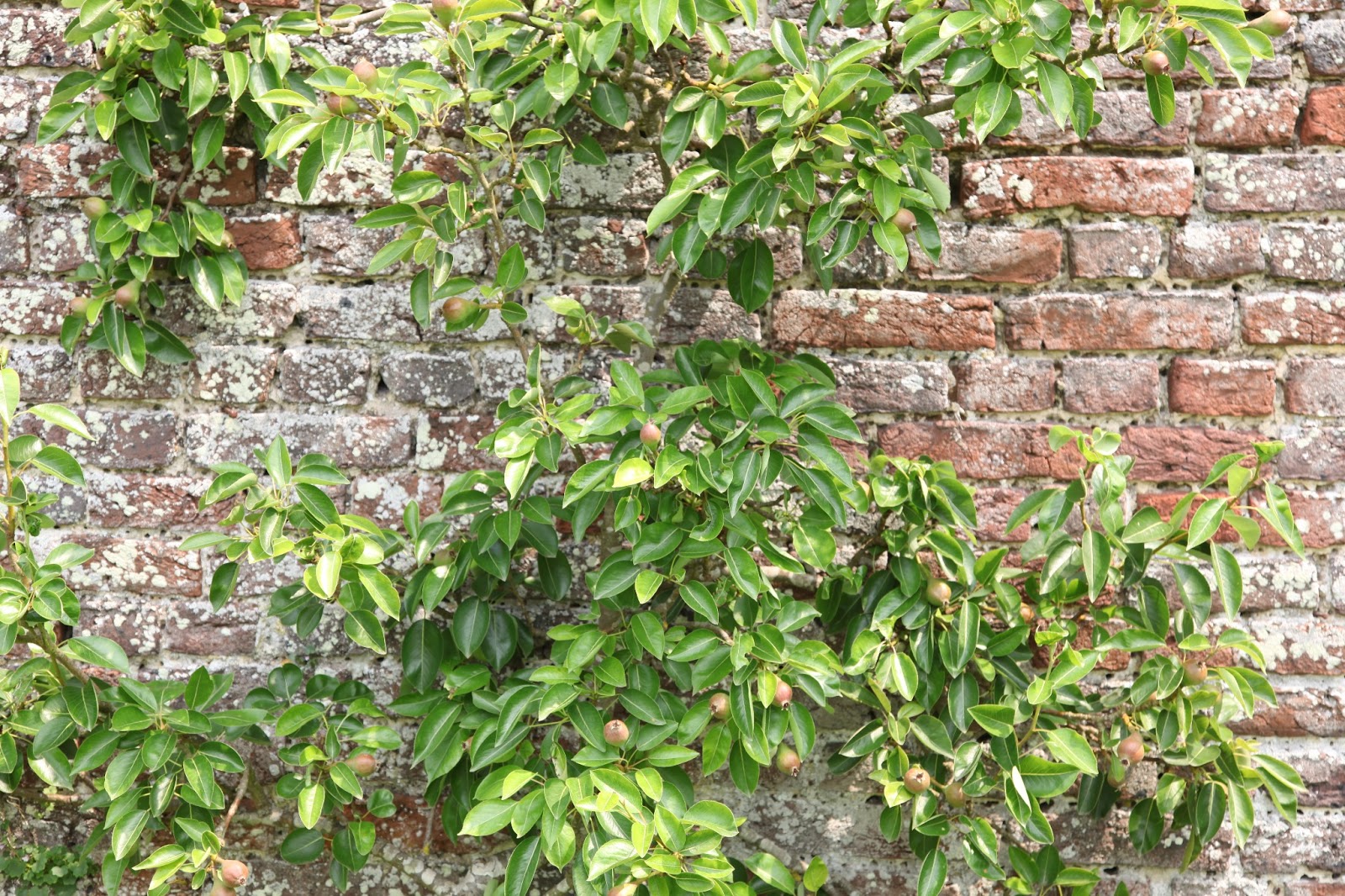
The first orchard was at the end of my walk around Penshurst Place Gardens. I’d read about them in the main house – they used to be in the Jubilee Walk, but the trees were dug up and transplanted. There is a national collection of fruit trees at Faversham called Brogdale. The new orchard at Penshurst uses older varieties of fruit trees from Brogdale, and there is something wonderfully fairy-tale like about it. 


As with the Mayfield Lavender field, I had written about an orchard in my story before I visited Penshurst – but I have been to orchards many times before. This is from a pick-your-own farm called Hewitt’s in Orpington that I like to visit, taken last autumn.

This has become a post about three orchards now. And a national fruit collection, which is an orchard too, although it describes itself wonderfully as ‘a living gene bank’. There is a directory of orchards in England (sorry Wales, Scotland and Northern Ireland), where you can find hundreds more.

More flowers from Penshurst Place


Minimal writing in this blog, which might please some; just lots of photos of one of the most beautiful gardens I’ve visited. If you live in the South East of England, Penshurst Place is one of the best day trips I could suggest for sunny weather, such as we’re due to have this weekend. But do be sensible and take sunscreen, sunglasses and water! If you are an RHS member, you get free entry to the gardens, and it’s only another couple of pounds extra to enter the house too.


First of all, there were hundreds of varieties of flowers. Delphiniums, lupins, lavender, roses, scabious, astrantia, dahlias, lady’s mantle, peonies (which have been the star of a separate post), primulas, irises, foxgloves…and plenty more that I don’t know the names of. Enjoy these.


There were fruit trees and baby strawberries aplenty, and I haven’t even included the orchard, which will feature in the next post.


The gardens generally are just so beautiful. Some of them are immaculate, others are a bit wild and wonderful, most of them are full of gorgeous scents, but every one is a delight to walk around.


I think I am getting the hang of this photography lark - I'm pleased with many of my 380 photos from the day!

Friday, 5 July 2013

A Lavender Field in London


I started writing a short story a month or so ago. It was just supposed to be an exercise in creative writing – I ask someone for three nouns and I put them into a story quickly and instinctively, without thinking too much or judging what I write.

Now, I don't recall ever seeing a film or gazing at a picture with a lavender field, and I'm sure I haven't read about them. I did see a photoshoot set in a lavender field, which I remember for the bohemian, 70s styling and the table flowers (which didn’t include lavender). But for some reason, as I started writing this story, the thought of a lavender field entered my mind, even though it wasn’t related to the three nouns I was given.

I visited Mayfield Lavender after I’d started this story. It’s a 25-acre lavender farm in Banstead in South East London/Surrey. I got the 166 bus from West Croydon, which is one of those lovely, quiet bus rides where you could happily fall asleep or look out of the window. What amazed me was the smell of the lavender – it hits you inside the bus, and that’s how you know you’ve reached your stop. The bus stops right outside – there’s a little wire-fenced path by the bus stop, so just follow it round to the main entrance. And if you’re getting the bus from Banstead town centre, the stop is just opposite.

I could see the field from the other side of the fence, but walking in through the entrance and into the field was just incredible. There was a group of young men and women on my bus who ran straight down the paths of the field and jumped and took photos straight away – that’s the sort of joy it evokes.


I walked along one path, jumped over to the next, sat down and looked at the blue and purple flowers above me and listened to their swishy rustle. I didn’t think about much, which is strange for me as I usually drive myself mad thinking about everything under the sun. So it’s not a clichĂ© – being in a field of lavender is genuinely relaxing! The only thing that stuck in my mind was – this is just how I imagined the field in my story.

I had a cup of lavender and Earl Grey tea and a lavender fairy cake in the cute café and shop, where I had a perfect view of the field and the lavender-coloured bicycle. Then I went for another walk in the field and sat on one of the picnic benches under a tree, watching the people hard at work weeding the field row by row.


When I finally dragged myself away, I got the bus to Banstead town centre and walked the 15-minute walk to the train station. I still had the scent of lavender in my nose, another thing I imagined in my story, but I suspect it was from sitting in the field or from the perfume samples I was given in the shop! The effect of the field remained with me, and I found myself taking photos as I walked along, when beautiful-looking things caught my eye. By the way, I didn’t have a camera with me, so all of these were taken on my phone. In my Zone 4 arrogance, I assumed the trains from Banstead would be at least every half hour. But no; they were every hour and I’d just missed one. It was ok though – it was sunny and warm, and I worked on my screenplay while I waited on the pretty station platform. The station is unstaffed, incidentally, but there are ticket machines.


Lavender is a herb that reminds me of front gardens on hot days, where the scent fills the air and bees buzz around the plant. The herb is becoming more prevalent because of the rising popularity of lavender in baking and cooking. For me, it first became a flavour as well as a fragrance when I made Nigella Lawson’s Lavender Trust cupcakes from her book Forever Summer. (The Lavender Trust at Breast Cancer Care supports younger women with breast cancer).

This weekend, there will be a festival at Mayfield Lavender, so if you live nearby, what better way to spend the first hot weekend in weeks? You can buy ready-made cakes and biscuits with lavender, or you can buy flowers to make your own. There will be activities for children and adults, food and drink, and the calming blue sight of 25 acres of lavender.

Tuesday, 2 July 2013

The Lonely Bouquet in Bromley


I had a lovely email from a man who found my lonely bouquet that was sitting in the Queen's Gardens in Bromley. He kindly sent me a photo of it in its new garden, guarded by an adorable 12-year-old Jack Russell called Nipper.

Monday, 1 July 2013

The Kindness of Strangers


What connects a London artist and a famous gallery with a group of florists in Belgium? The first two have just staged the first of two weeks’ worth of…what would you call it…performance art? Audience participation art? Fact-inspired fiction? And the second has inspired an international movement that kind of feels like the grown-up, midsummer version of a child’s visit from Father Christmas.


Speak to Strangers is a project where artist and writer Gemma Seltzer sets up with a blanket, some strawberries, and a sign inviting strangers to talk to her and tell their stories. For the past week and for the next five days, Gemma was and will be on the south side of Tate Modern from 11am to 2.30pm, giving Londoners the chance to quash the stereotype that we are the most unfriendly and contemptuous bunch of people in Britain. And give visitors to London the chance to show that they’re definitely not unfriendly or contemptuous. In fact, given the chance to talk to someone we’ve never met before, who warmly invites us to share a little bit of our story with them, we’re interested and curious and friendly.


Gemma uses the stories she gathers each day (yes, even on the day I saw her, when it was pouring with rain, we strangers with stories still flocked to her) to write a 100-word short story. Her previous work has included an enchanting tour of London at the wondrous hour of 5am. As an insomniac, an early-bird and late-night writer, and a get-the-5.30am-train-to-the-market florist, I was fascinated to read the thoughts of someone who is not used to seeing London at such an odd time, and there is a mysterious text message behind the tour that will have you musing over it the next time you wake up earlier than usual. It's also intriguing to see photos of the capital at 5am at different times of the year.

Now to Belgium, where a group of flower farmers and florists have started a guerrilla movement that has swept over the world. Yesterday was International Lonely Bouquet Day – where flower and nature-lovers gathered flowers from their gardens, fields, allotments, and made posies and bouquets, which were then left with an ‘Adopt me’ note in public places for strangers to find. The strangers could keep the flowers for themselves or give them to someone as a gift. Some of the adopters reported back with stories of what happened to the bouquet and photos of the happy adopters.


I really enjoyed taking part in this. If you’ve been following my blog or my work, you’ll know that I am a romantic florist – I do it because it’s exciting, beautiful, inspiring, and because it brings joy to people – so the idea of making lonely bouquets was wonderful to me. I especially loved the green aspect of it; rather than using shed-loads of mass-produced wholesale flowers, we would have to forage with scissors and secateurs for our own. The bouquets would be seasonal, local, wild, beautiful and quite possibly scented. Fleuropean, the group behind the movement, encourages using recycled glass jars as containers, so I set about decorating some of mine, Blue Peter style, with beautiful pictures from The RHS’s The Garden magazine and the David Austin Garden and Home catalogue. I also used beautiful photos from the catalogue to fashion labels for each bouquet – so strangers would know they were up for adoption and not merely abandoned!


I used lots of red, pink and apricot roses, including gorgeous ‘Cariad’ David Austin Roses, which all smelt amazing. I used plenty of philadelphus (mock orange), a glamorous white flower that smells like a cross between jasmine and honeysuckle. I also used scabious, osteospermum, matricaria daisies, and escallonia ‘Apple Blossom’. For foliage, I used jasmine, chunky pittosporum and the thinner, ‘Oliver Twist’ variety, lemon mint, and orange thyme. Each bouquet was so scented – I really hope the adopters got a kick out of this.


I left the first in the little Desmond Tutu Peace Garden in the huge Chinbrook Meadows in Grove Park. This little haven was opened by Desmond Tutu himself four years ago; he used to live nearby once upon a time. It’s a lovely garden, designed by Chris Beardshaw, that represents peace and harmony. It was the perfect place for a lonely bouquet…and as I turned to look back, after I had left the meadows, I saw a man walk over to it, lift it up and sniff it, and take it away. I can’t begin to describe what a thrill that was! I hope he or the person he gave it to enjoyed it.


The second bouquet was the smallest, but also the most delicious, containing mint and thyme. I really like using thyme in arrangements now – it smells stronger than mint and it lasts well in water. I left it outside an entrance to Lewisham Hospital, which many of you will have heard of because of the planned changes to the emergency and maternity units. By a complete coincidence, Desmond Tutu also opened a unit at the hospital and has voiced his support for the Save Lewisham Hospital campaign! I waited a while from a distance, but not many people came past and no one seemed to notice it. I could have left a bigger bouquet, but I was worried about people not having enough room by the hospital bed or having to lug it home on the bus after visiting. Well, hopefully it got adopted later.


I took the last bouquet on a bus to Bromley and left it on an empty bench in the busy Queen’s Gardens behind the shopping centre. I’m not sure how quickly it got snapped up, but it wasn’t there when I walked by half an hour later.


There is a map where you can see if there are lonely bouquets in your part of the world. Flower fairies can upload pictures of their lonely bouquets and tell us if they are confirmed adopted or up for adoption. And adopters can upload photos of their finds. My friend showed this map to her young son yesterday. He was so inspired by the map (his town was sadly lacking lonely bouquets) and the photos that he did two things. First, he cut a rose from his garden and got his mother to send a photo of it to me, so I could have a rose in thanks for my flower donating. Second, he asked if he could make a lonely bouquet himself today and leave it for someone to adopt. How completely wonderful! I love his enthusiasm and also his refusal to fit into some kind of 'boys don't like flowers' mould.

Fleuropean say: ‘The ultimate goal of this initiative is to dedicate one day a year to making strangers happy.’ Flowers and the sharing of stories – what a great way to do this.

Sunday, 30 June 2013

Happy Lonely Bouquet Day

Today is Lonely Bouquet Day, a day for lovers of flowers from gardens and the nature around us, to make a bouquet and leave it for a stranger to find and adopt. It's a wonderful idea, and I've made three lonely bouquets. I'm just off to deliver them now....I'll update afterwards!

Thursday, 27 June 2013

Peonies at Penshurst Place


I visited Penshurst Place for the first time this week.  Inspired by Claire Austin’s talk at Wisley, I wanted to catch the peonies before their season finished (it’s a shame they’re so ‘blink and you’ll miss us’) and also test out my nervous, new photography skills in a beautiful setting. I took 382 photos! Thank goodness for digital cameras.

I’ll focus on peonies here and I’ll write another post or two for the rest of the gardens, otherwise this post will be mammoth.

What I loved about the peony border is that you walk around the first gardens that you come across, looking from pear tree to lavender shrub, and you enjoy it so much, you forget what you came to see in the first place. Then you turn a corner and – wow. The scent along nearly knocked me off my feet. There are four varieties on display, from hot pink (Mons Jules Elie) to the ice cream and blush shades of Lady Alexander Duff, Albert Crousse and Sarah Bernhardt.

The border is one hundred metres long. Imagine a sprint set alongside it – it would draw the most languid runners, stopping to look, touch and sniff as they ambled along.