Showing posts with label Mint. Show all posts

Monday, 12 June 2017

Love and loss with flowers


Mother's Day feels like so long ago now - but it was only a few months ago. 

The alternative flowers workshop went well. I had rosemary and forget-me-nots for remembrance, mint for warmth of feeling and protection, ranunculus which says "You are radiant with charms" according to the Victorians. And French lavender, just because it smells beautiful.


There were people who'd lost their mother and people who'd lost their child, but everyone connected and shared their stories. I went down to get more tea after we'd been chatting for an hour and before we started the floristry, but when I came back up, everyone had got stuck in and started making posies. There was flower-swapping and jar-swapping, and beautiful, scented posies were made for keeping and others were made to lay in memory. It was heartbreakingly sad at times, but it was also wonderful. The talking, the connecting, the kindness, and the grounding qualities of flowers - all of these things did their bit.


If you would like support with the loss of a child, Child Bereavement UK have resources here.
For other bereavements, you can contact Cruse here.

Tuesday, 26 August 2014

August flowers


I hope you had a good bank holiday weekend. It's been too cold for summer and has felt rather miserable in South London - the sky was filled with rain and dark clouds for the last few days. But it meant a lovely afternoon spent making a compilation MiniDisc (don't ask) for an upcoming trip to Wales - here's my sketch for #DrawingAugust yesterday.


Here are some flowery photos from this month. Pink cleome and white Cosmos 'Sensation' by a fence.


The first Delphinium 'Galahad' to flower. I was very happy about this!


Beautiful lavender-coloured flowers on scented lavender mint.


The cool silvery leaves of Senacio cineraria were warmed up by the bright, dandelion-like flowers.


The dedicated cut flower patch has grown into a bit of a monster. Cornflowers and panicum are hidden behind ammi at the back, whereas cosmos is over 150cm tall at the front with stems as thick as rhubarb. Yes, yes, I got things back to front. I live and learn! I let my sweet peas go to seed and have collected a few bags of seeds for the first time. I've no idea if I've done it properly - I'll have to see what happens when I try to grow them. I gave some to the lovely Sara Willman who I met in London when she and her husband visited the city last week. I also collected some panicum seeds, but as you can see from her photos, she has no need for grass seeds! Here's the only red zinnia from my 'Early Wonder' mix with sweet pea pods.


I can't wait for more sweet peas next year. And I'll try to grow more autumn-sown cornflowers successfully this time.


The pollen from cosmos is a pain when arranging flowers, but it's all for a good cause - the pollinators love it.


Saturday, 2 August 2014

A floral photography lesson from Amo La Fotografia


One thing I found difficult last year when I started learning how to use a photographer's camera and lenses (rather than my usual point-and-click or my mobile phone), was how to photograph white and pale flowers, especially when mixed with darker flowers. In this posy, the white roses lost their beautiful definition in my photos and just looked like big balls of white light!

So I was delighted when the lovely Kent-based photographer, Karen Louise of Amo La Fotografia, offered to give me an online lesson in photographing white flowers, along with other tips to improve flower photography indoors and outside. The ISO needs to be a low number (e.g. 100), the F-stop depends on whether you want detail in the background as well as the subject - a lower number for less detail in the background, and a faster shutter speed will result in a less exposed (light) photo. I am used to using the histogram as a guide, not the shutter speed, so this was all new to me. But...it works! It's quite hard to get out of old habits, and I can see that many of my photos could improve if I were a bit braver. As Karen Louise says in her tutorial, it's easier to 'correct' underexposed (darker) photos with an editing tool than it is to correct overexposed (lighter) photos. And incidentally, when you look at her tutorial you'll see her flower arrangements are as gorgeous as her photos!

Here are some photos I took of a couple of "all in the garden" arrangements, after reading the lesson. I'm a bit annoyed by the 'Penny Lane' dahlia sticking out like a sore thumb in the middle of the big arrangement - I actually removed it at the last minute before it was delivered - but never mind. The huge heads of white phlox are what I was worried about photographing, but I love how the detail  is kept by using a faster shutter speed. The tiny white flowers of Moroccan mint (I used lavender, orange, and pineapple varieties too) also kept their detail, and the white and red flowers of the 'Hot Lips' salvia kept more detail than usual. And you can't photograph scent, unfortunately, but both arrangements were highly scented, thanks to the wonderful phlox, mints, lemon balm/Melissa, sage, nicotiana, and sweet peas.


Saturday, 28 June 2014

Lonely Bouquet Day 2014


Sunday is Lonely Bouquet Day 2014. If you saw last year's post, you'll know what a lovely idea I think it is. Although people can and do leave lonely bouquets throughout the year (as I did for British Flowers Week), the day in June is designed so that people can make the most of the flowers available in their gardens, or their kind friends'/ neighbours'/families' gardens. The bouquets are made by florists and non-florists alike, from local flowers and foliage, and left in a recycled container of water for someone to find (in locations all over the world).

I started off the weekend by leaving a lonely bouquet of red, pink and yellow roses and pink hydrangeas outside Lewisham Hospital; it was adopted (by I don't know who) within twenty minutes.


I made up four more bouquets which are ready to be abandoned - I'm planning to leave them in various places in Lewisham, Bromley and Greenwich boroughs. Keep your eyes peeled!


There are more hydrangeas, roses, Escallonia 'Apple Blossom' and Pittosporum 'Oliver Twist', as well as Salvia 'Hot Lips', 'Genova' dahlias, pineapple mint, melissa (aka lemon balm), Lavender 'Vera', osteospermum, sweet peas, hebe, cornflowers, and pretty, silvery senecio cineraria. You can imagine the scent of the sweet peas, sage, mint, melissa, lavender and roses!


The containers are a couple of random glass jars, as well as a beautiful Tiptree tea caddy and a Women's Institute jam jar that I've been hoarding!


If you're taking part in Lonely Bouquet Day, or you were lucky enough to find an abandoned bouquet, I'd love to hear your story.


Thursday, 12 June 2014

Carers Week 2014 and the story of Genova


This week, in between last week's Volunteers' Week and next week's British Flowers Week, is Carers Week. It is an awareness campaign to draw attention to carers in the UK and the unpaid, vital work they do, which is estimated to save the economy £119 billion each year. Several organisations have worked together for this year's Carers Week: Age UK, Carers UK, Carers Trust, Independent Age, Macmillan, Marie Curie Cancer Care, Multiple Sclerosis Society, Parkinson's UK, Skills for Care, and Stroke Association.

I volunteer as a counsellor at two organisations - one is a local carers association, and the other (pending the results of my role play assessment last week) will be at a local hospice. I will be taking flowers and seedlings to the carers association next week as a belated gift for Carers Week and in celebration of British Flowers Week.

Today I took some posies to the hospice. The receptionist, who did her volunteer training with me, was delighted with them. She could smell the roses (which won't last long in this heat, but hey - I'd rather these than unscented supermarket flowers) and I could smell the mint as I took them out of their packaging for her. Hopefully they brought a smile to some people at the hospice - carers, patients, workers and volunteers.


I used lots of wonderfully-scented herbs: pineapple, lavender, orange and Moroccan mints, white and lavender-pink flowering lemon thyme, and lemon balm (aka Melissa). I also used the first of the jasmine flowers, as well as sweet peas, nigella flowers and seedpods, cornflowers, roses, hot pink escallonia, and my first dahlia - a pale rose flower which I bought from Shannon's Garden Centre partly for its name 'Genova'. Genova is a film by Michael Winterbottom about a widower (played by Colin Firth; it's my second-favourite Colin Firth role after his portrayal of a grieving partner in A Single Man) dealing with his bereavement and his daughters'. It wasn't planned, but it seems fitting that my first 'Genova' dahlia has gone to a hospice.


Friday, 16 May 2014

The first nigella and roses of the year


After nine months of nurturing, my Nigella 'Moody Blues', which I grew from Sarah Raven's seeds, began to flower this month. Nigella are a beautiful, fairy-like flower that I never came across when I did my floristry course or when I worked for other florists. I think they deserve to be used more often - they are such a delicate-looking flowers, but last well in water. Here is my first one, along with a couple of early sweet peas.


The first roses began to flower too, and the scent hits you as soon as you step outside.


I was longing to make my first garden rose and nigella posy of the year! I added lots of sweet-smelling herbs - both lemon thyme and flowering orange thyme, and last year's apple mint (which is doing even better this year) and lavender mint. Combined with the scent of the roses, this is a posy that fills a room.


The odd bits of thyme, rosebud and nigella were used in a tiny Tiptree jar. I don't like wasting flowers! The rest of the flower waste gets thrown on the compost heap.


Since I don't like flower waste, I got these from my lovely local florist, Julie at the Grove Park florist shop. She was going to throw them out, and didn't want to take money for them, but I did manage to pay her a little for them. I've talked about how difficult it is to manage a flower shop before - one day you sell out of everything, but another day you end up throwing half of your stock out.


As ever, my message is: please buy flowers and plants from your florist or garden centre when possible, and not from a big supermarket. Or grow your own!

Thursday, 3 April 2014

RHS Great London Plant Fair


I filled in a survey for the RHS a few months ago. Some of the questions asked whether RHS membership was good value for money or not. I realised it is very good value for money, provided you make use of it, which I haven't really in the three years I've been a member.  So I vowed to make more of an effort and visit its gardens and partner gardens more often, and go to the London shows held in the RHS Horticultural Halls (which are free for members).

So after a heavy day of co-facilitating group counselling, followed by supervision, I got a train to Victoria and walked over to the halls, passing several people with narcissi-filled bags on the way!

The displays and the plants for sale in the Lawrence and Lindley Halls were a wonderful taste of spring, while the Early Daffodil Competition filled a wall with daffodils large and small. The RHS also ran tours of the Lindley Library in keeping with the theme of the show - gardening in a changing climate. We were shown huge, painstakingly written and preserved books and artworks from different eras, starting with the 1580s, and going all the way up to this century. It is amazing that botanical drawings were copied by hand, losing details and accuracy along the way. Some images, such as a drawing we saw of a banana plant, were not drawn accurately in the first place, and subsequent books featured hand-drawn copies of the same image - all with the bananas growing upside down!

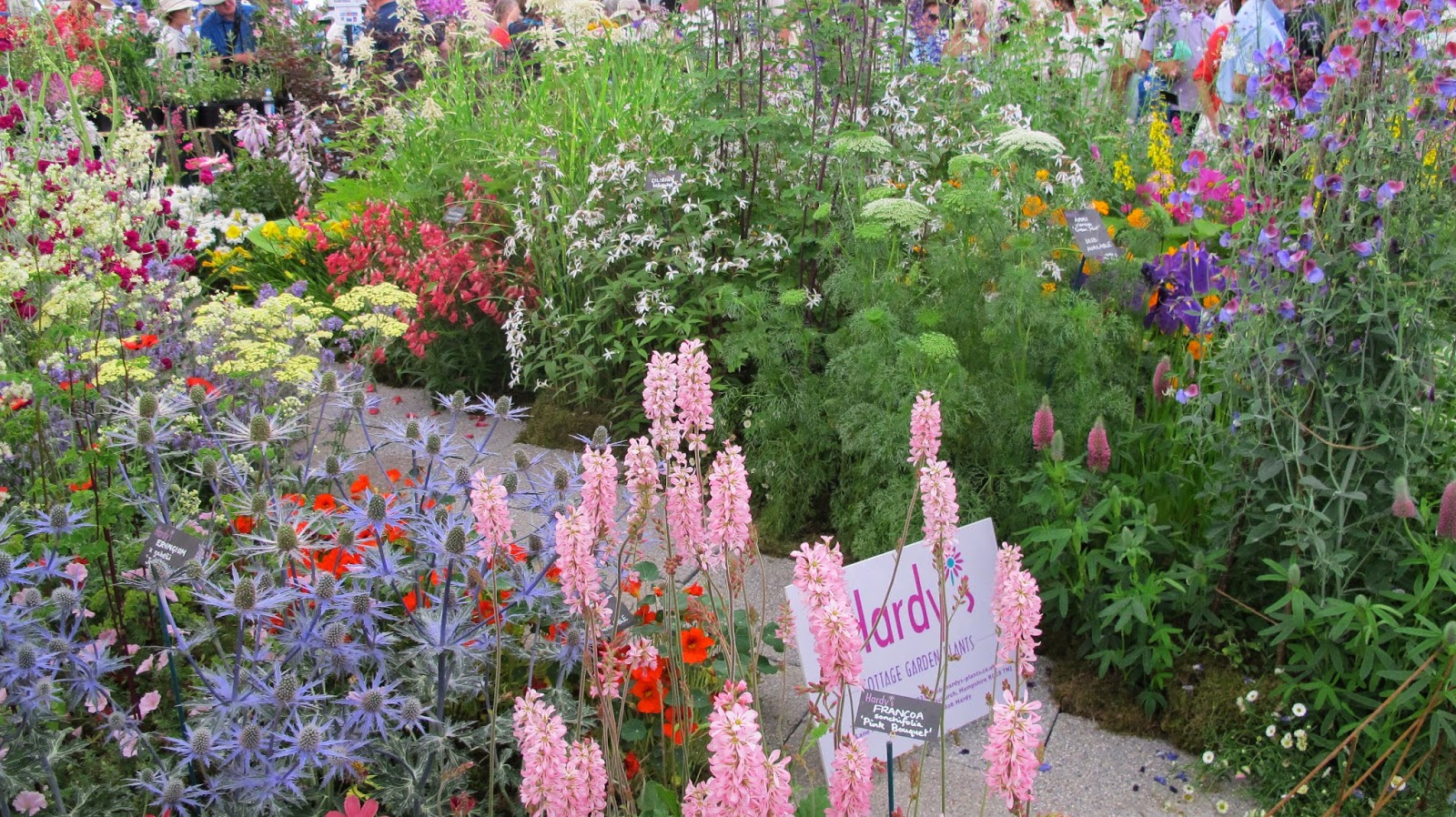
I bought some cowslips (Primula veris) from Hardy's Cottage Garden Plants. I love Hardy's - they always put on a beautiful display at shows, like this display at Hampton Court in 2013. The poppies in the second photo are Papaver commutatum and the stunning white flowers in the third photo are Campanula 'Jenny'.


I've yet to visit their nursery in Hampshire, but it is on my to-visit list, not least because it is near the real Watership Down. Richard Adams' fantastic, epic novel was set in the surrounding countryside, and I long to visit the area one day, as the book and the 1978 film have been favourites of mine since childhood. Cowslip features in the book as a coveted source of food at the beginning, and as a bizarre rabbit in the middle.

I was advised to plant the cowslips in a grassy but unmowed area, and hopefully they will spread. Fingers crossed - I would love to have more of these beauties!


I got some lemon thyme and Moroccan mint from Pennards Plants - another showstopper. These photos are also from Hampton Court last year.


The lemon thyme smells incredible. I bumped into a friend on the train home and got him to smell these amazing herbs.


Finally, I was there for the plant sale before the show finished, when you can buy some of the plants that have been used in displays. I got a Primula auricula from the Silver Gilt medal-winning display by Cath's Garden Plants. I think this is Gold Lace.